
Most startup founders skip tax planning entirely, treating it as an afterthought once revenue arrives. This mistake costs thousands in preventable taxes and missed deductions.
At Bette Hochberger, CPA, CGMA, we’ve seen how the right tax strategy for startups transforms profitability from day one. The decisions you make now-your business structure, expense tracking, and payment schedule-directly determine how much capital stays in your company.
Why Tax Strategy Matters for Startups
Tax Planning Cannot Wait Until Year-End
Most founders treat tax planning as a March ritual when filing deadlines arrive. This approach costs thousands in preventable taxes and missed deductions. The Federal Tax Code rewards proactive planning, not reactive filing. When you postpone tax strategy until year-end, you’ve already lost deductions, paid unnecessary self-employment taxes, and missed opportunities to structure compensation in ways that reduce your overall tax burden.
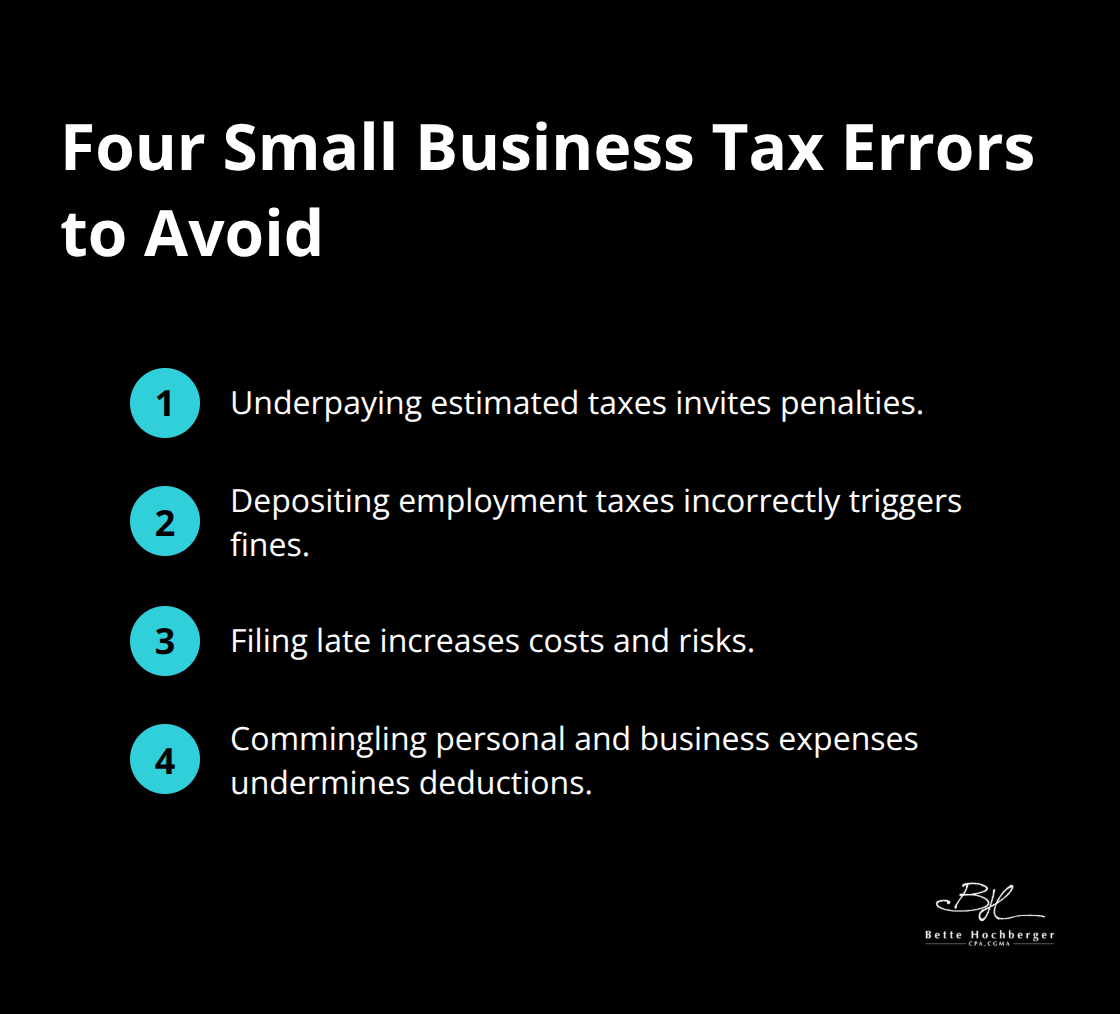
The IRS Tax Tips 2019-164 identifies four common tax errors that plague small businesses: underpaying estimated taxes, depositing employment taxes incorrectly, filing late, and commingling personal and business expenses. Each of these errors is preventable with a plan made in Month One, not Month Twelve.
Entity Selection Shapes Your Tax Burden and Future
An S Corporation can save a founder on self-employment taxes compared to a sole proprietorship or LLC taxed as a partnership, depending on your income level and business type. That savings stays in your bank account instead of going to the IRS.
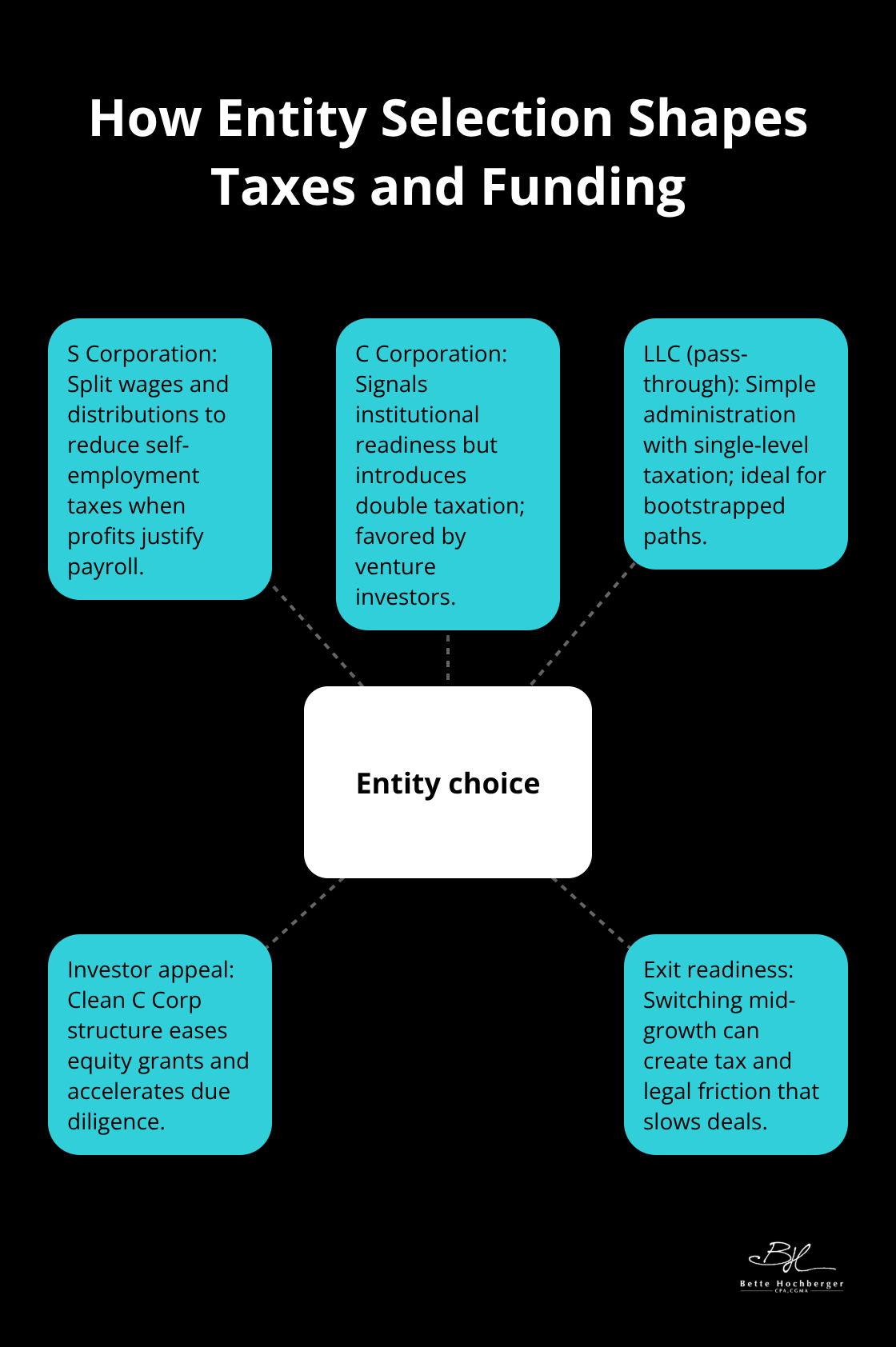
Entity selection also shapes how attractive your startup looks to investors and acquirers. A C Corporation signals institutional readiness and simplifies equity grants for future employees, while an S Corporation or LLC might complicate due diligence later. Your choice today affects your fundraising story and exit options years down the road.
Deductions Compound When You Track From Day One
Home office deductions, equipment depreciation, health insurance premiums for yourself and employees, and professional services all reduce taxable income dollar-for-dollar when documented correctly. Track expenses from Day One using a separate business credit card and accounting software to eliminate the chaos of reconstructing receipts in December.
Quarterly estimated tax payments prevent penalties and keep cash flow predictable. The IRS expects you to pay taxes as you earn income, not in one lump sum at year-end. Underpaying triggers penalties even if you eventually pay in full, according to IRS Tax Tips 2019-164.
A Tax Professional Identifies Credits You Qualify For
A tax professional who understands startups can model different entity structures, estimate your tax liability based on revenue projections, and identify which credits you actually qualify for. The R&D Tax Credit applies if you experiment to improve your product, for example. These conversations happen best before you’ve locked yourself into a structure that creates tax drag for years. Your next step involves selecting the right entity structure and understanding how that choice cascades through your entire financial picture.
Tax-Efficient Business Structure Saves Thousands
S Corporations Deliver Self-Employment Tax Savings at Scale
S Corporations offer the biggest tax advantage for most startups once revenue reaches a certain threshold, typically $60,000 or higher in net profit. An S Corporation lets you split income between W-2 wages and distributions, paying self-employment taxes only on the W-2 portion. If you earn $100,000 in net profit and pay yourself a reasonable $60,000 W-2 salary, you owe self-employment taxes on $60,000 instead of the full $100,000. That difference amounts to roughly $5,700 in annual self-employment tax savings, money that stays in your business.
The catch involves real trade-offs. S Corporations require more accounting complexity, quarterly filings, and payroll processing. Before your revenue justifies this overhead, a single-member LLC taxed as a sole proprietorship keeps things simple while you validate product-market fit. The S Corporations self-employment tax savings compound each year and fund reinvestment or founder distributions that fuel growth.
C Corporations Signal Institutional Readiness
C Corporations make sense only if you plan institutional fundraising or acquisition within three to five years. Venture-backed startups typically incorporate as C Corporations because investors expect it, and the structure simplifies equity grants for future employees. However, C Corporations trigger double taxation: the company pays corporate income tax on profits, then shareholders pay individual tax on dividends. For a bootstrapped startup, this structure wastes money.
An LLC with pass-through taxation avoids this problem entirely, letting profits flow to your personal return taxed once. The real decision comes down to your funding timeline and growth velocity. If you’re raising a seed round from institutional investors, incorporate as a C Corporation now and accept the complexity. If you’re bootstrapping or planning a lifestyle business, an LLC keeps tax drag minimal and administrative burden low.
Entity Selection Shapes Your Exit Narrative
Entity selection determines how attractive your company appears during due diligence. Acquirers and investors conduct detailed reviews of your corporate structure, cap table, and tax compliance. A C Corporation with clean equity records and formal governance closes deals faster than an LLC with unclear ownership. Conversely, switching from an LLC to a C Corporation mid-growth creates tax complications and legal friction that slows momentum.
The structure you choose today shapes not just your tax bill but your entire exit narrative. Switching structures later becomes expensive and complicated, so model your likely path over the next three to five years before deciding. If institutional capital or acquisition seems probable, incorporate as a C Corporation despite the immediate complexity. If you’re building a sustainable, profitable business without external funding, an S Corporation once profits exceed $60,000 delivers tax efficiency without the administrative weight of a C Corporation.
Practical Tax Moves Depend on Your Structure Choice
Your entity structure determines which deductions you can claim and how you report them. A C Corporation files Form 1120, an S Corporation files Form 1120-S, and an LLC files Form 1065 or reports on your personal return depending on elections. Each structure carries different rules for home office deductions, equipment depreciation, and health insurance premiums. Getting this right from the start prevents costly corrections later and positions you to capture every eligible deduction.
The decisions you make about entity structure ripple through your entire tax picture for years. Once you’ve selected your structure and understand the deductions available to you, the next step involves implementing the specific tax moves that protect your cash flow and maximize what you keep.
What to Implement in Your First Year
Pay estimated taxes quarterly, Not Once at Year-End
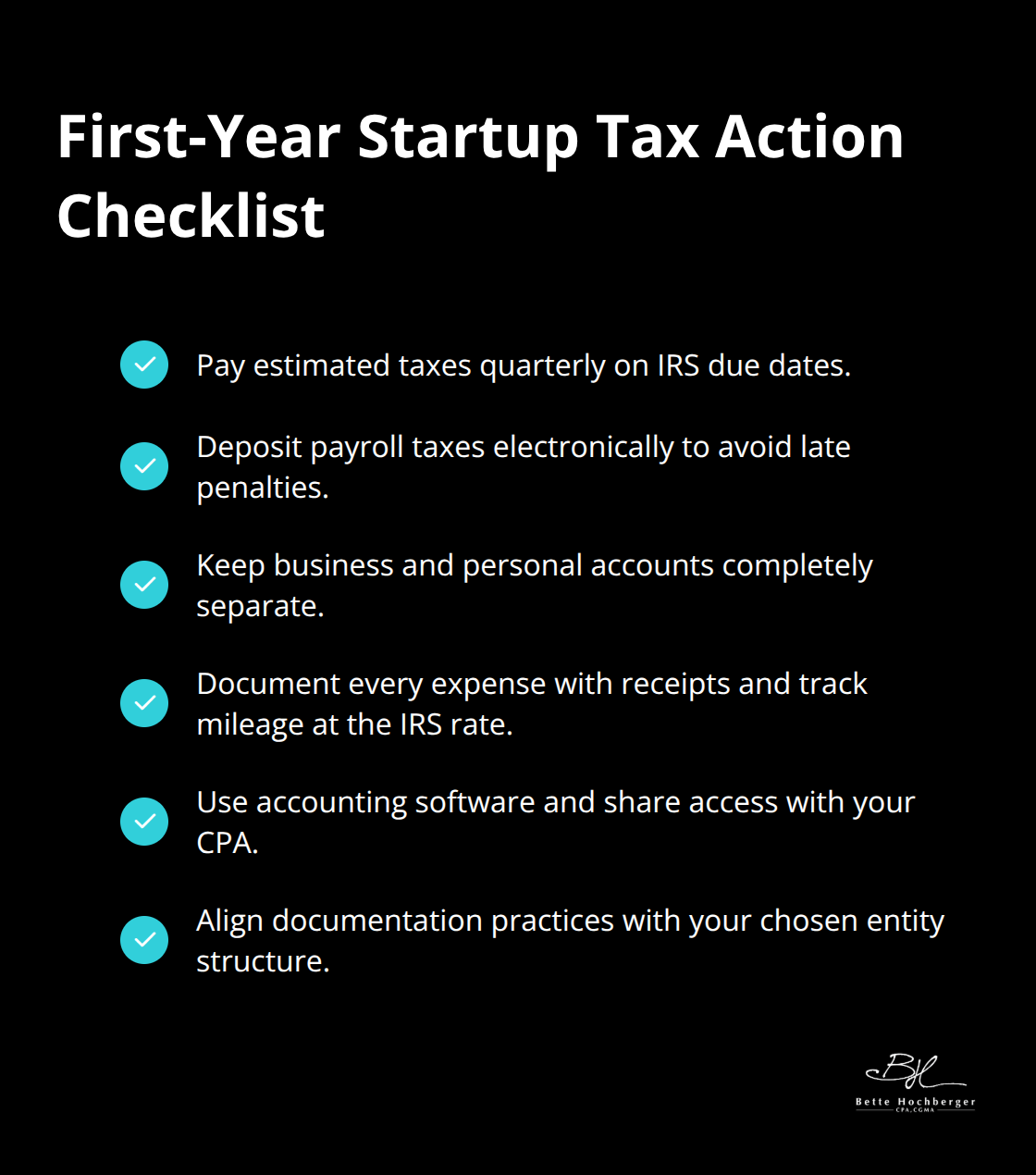
Start estimated tax payments immediately, not after your first profitable month. The IRS expects you to pay taxes quarterly as income arrives, and underpaying triggers penalties even if you eventually pay the full amount owed. Calculate your estimated tax by projecting annual revenue and multiplying by your effective tax rate, then divide by four. Most startups deposit payments electronically on April 15, June 15, September 15, and January 15 to align with IRS deadlines.
Deposit payroll taxes electronically as well to help ensure timely and accurate payments, avoiding late-deposit penalties that compound quickly. This discipline prevents cash-flow surprises and keeps the IRS satisfied that you’re meeting your obligations throughout the year rather than scrambling in March.
Separate business and personal finances Completely
Use a dedicated business credit card and bank account from day one. If the IRS finds that you’ve mixed personal and business funds, they may disallow deductions, assess back taxes, and add penalties or interest. This separation also simplifies year-end reconciliation and gives your accountant clean data to work with instead of reconstructing transactions from mixed statements. The clarity you build now saves hours of frustration later and protects your deductions if the IRS ever questions your return.
Document Every Business Expense With Proof
Tax deductions require proof, so maintain receipts, invoices, and bank statements for at least three years in case of audit. Home office deductions apply if you use a dedicated space exclusively for business, calculated either as a simplified $5 per square foot (up to 300 square feet) or actual expenses including rent, utilities, and insurance. Equipment purchases over $2,500 typically qualify for depreciation over several years under IRS Publication 535, though certain assets may qualify for immediate expensing under Section 179.
Professional services, business insurance, licenses, permits, and employee benefits all reduce taxable income dollar-for-dollar when documented. Track mileage if you drive for business purposes at the IRS standard mileage rate, which was 67 cents per mile for 2024. These records transform vague expenses into defensible deductions that protect your cash flow and reduce what you owe.
Use Accounting Software to Automate Record-Keeping
Accounting software automates transaction categorization and maintains organized records, easing year-end preparation and reducing the chaos of December scrambling. You can invite your CPA to access clean, organized financials, reducing spreadsheet handoffs and email back-and-forth. This real-time visibility lets your tax professional spot opportunities and flag issues before they become problems.
Align Documentation Practices With Your Entity Structure
Your entity structure determines which deductions apply and how you report them on your specific tax form. A C Corporation files Form 1120, an S Corporation files Form 1120-S, and an LLC files Form 1065 or reports on your personal return depending on elections. Each structure carries different rules for home office deductions, equipment depreciation, and health insurance premiums. Align your documentation practices with your chosen structure from the start to capture every eligible deduction and avoid costly corrections later.
Final Thoughts
Tax strategy for startups isn’t optional-the founders who treat it as a foundational business decision from Month One retain significantly more capital than those who postpone planning until tax season arrives. Every choice you make now, your entity structure, your expense tracking system, your payment schedule, compounds over years and directly determines how much money stays in your business instead of flowing to the IRS. Proactive tax planning works because it prevents costly mistakes before they happen: underpaying estimated taxes triggers penalties you can’t recover, commingling personal and business expenses invites audit risk and lost deductions, and selecting the wrong entity structure locks you into years of unnecessary self-employment taxes or double taxation.
The startups that outpace their competitors typically share one trait-they aligned their tax strategy with their business strategy from the beginning. They modeled different entity structures against their funding timeline, documented expenses from day one using clean systems, paid quarterly taxes without scrambling, and identified which credits applied to their specific situation. This discipline freed up capital for product development, hiring, and market expansion instead of wasting it on preventable taxes.
Your tax strategy should reflect your actual business path over the next three to five years, and we at Bette Hochberger, CPA, CGMA specialize in helping startups design tax-efficient growth strategies that align with your specific business goals. Strategic tax planning, fractional CFO services, and outsourced accounting give you the clarity and systems you need to make confident decisions now and capture every dollar you’ve earned. The time to start is today, not when your accountant asks for receipts in March.