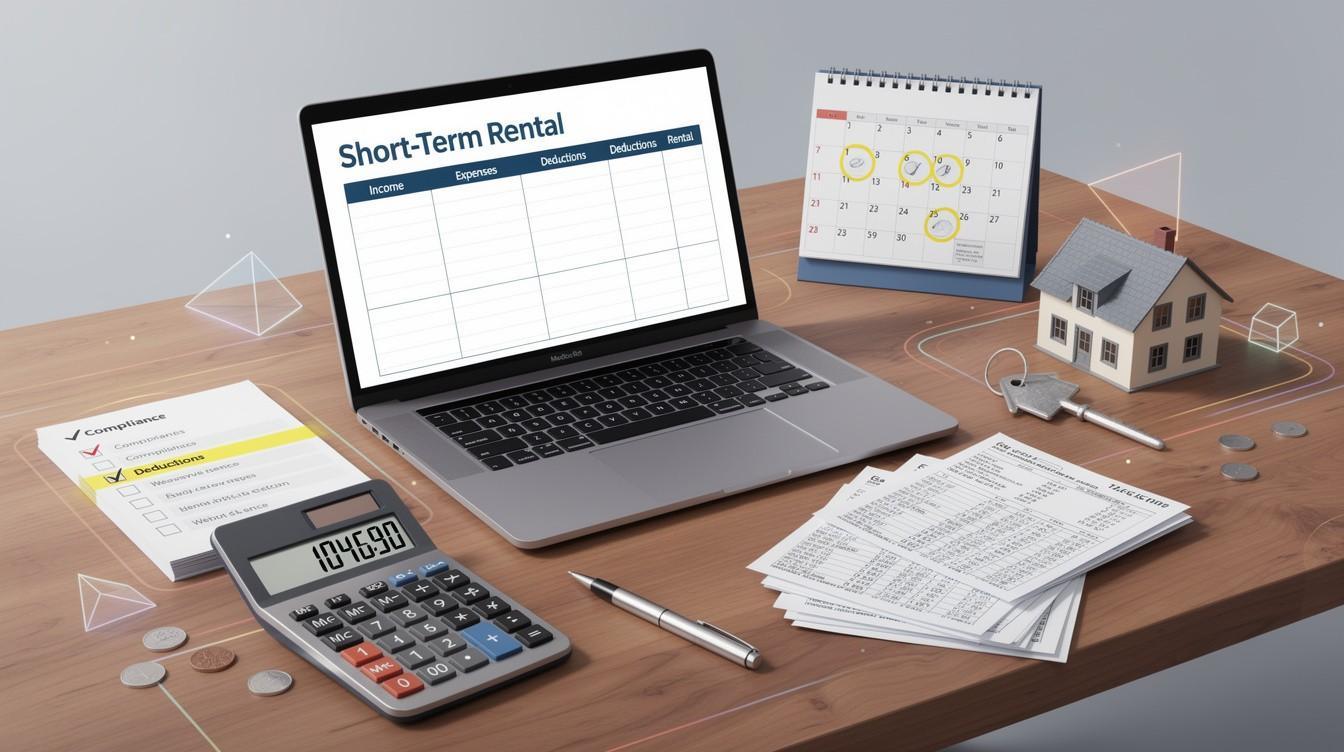
Real estate investors often leave thousands of dollars on the table each year by missing deductions and tax strategies they’re entitled to claim. Investment property tax planning isn’t just about filing returns-it’s about structuring your portfolio to keep more of what you earn.
At Bette Hochberger, CPA, CGMA, we’ve helped countless investors identify overlooked deductions and implement strategies that meaningfully reduce their tax burden while improving returns.
What Deductions Can You Actually Claim on Rental Property
Mortgage interest and property taxes Drive Your Largest Deductions
Mortgage interest stands as your largest deductible expense, and many investors fail to optimize this benefit. According to IRS Publication 527, you deduct the interest portion of your mortgage payments, not the principal, which means tracking your loan statements matters significantly. Points paid at loan closing are amortized over the loan term rather than deducted in year one, so a $10,000 point on a 30-year mortgage yields roughly $333 annually. Property taxes are equally important and fully deductible in the year you pay them. These two categories often represent 40 to 50 percent of your total deductible expenses, making accurate documentation essential for maximizing your benefit.
Depreciation Creates Non-Cash Deductions That Cut Your Tax Bill
Depreciation is where most investors leave money on the table. The IRS allows you to deduct the cost of residential rental property over 27.5 years and commercial property over 39 years, creating a non-cash deduction that reduces taxable income without touching your bank account. Cost segregation accelerates depreciation benefits by reclassifying components into shorter useful lives-appliances and carpeting depreciate over 5 years, furniture over 7 years, and landscaping over 15 years according to IRS Publication 946.
A cost segregation study on a $500,000 property can shift $80,000 to $120,000 of costs into shorter-lived categories, generating substantially larger deductions in early years. You should conduct a cost segregation study for any property acquisition above $250,000 to capture this advantage.
Operating Expenses and the Repair-Versus-Improvement Distinction
Operating expenses complete the picture: mortgage interest, property taxes, insurance, repairs, utilities, HOA dues, property management fees, advertising, and professional services all qualify as deductible expenses when they are ordinary and necessary. Repairs maintain your property’s condition and you deduct them immediately, while capital improvements that add value or extend useful life you capitalize and depreciate. This distinction directly impacts your current-year tax liability and your long-term basis calculations, making it critical to classify expenses correctly.
The difference between these two categories affects both your immediate tax position and your eventual gain calculation when you sell. Understanding which expenses fall into each category positions you to implement the strategic tax planning strategies that follow.
Tax Strategies That Actually Defer Taxes and Build Wealth
The deductions covered earlier reduce your current tax bill, but strategic planning structures your entire portfolio to defer taxes and accelerate wealth accumulation. Three approaches-1031 exchanges, Opportunity Zone investments, and entity optimization-work differently and serve different situations, so understanding when to deploy each one matters more than treating them as generic solutions. Evaluate these strategies early in your investment timeline rather than scrambling to implement them after a sale closes, because timing windows and eligibility rules create real constraints that advance planning solves.
1031 Exchanges Require Speed and Structure
A 1031 exchange defers capital gains taxes when you sell an investment property and reinvest the proceeds into a like-kind replacement property, according to IRS Topic No. 409. The mechanics are strict: you have 45 days from closing to identify potential replacement properties and 180 days total to complete the purchase. Miss either deadline and the entire transaction becomes taxable. You must use a qualified intermediary to hold the sale proceeds-you cannot touch the money yourself or the exchange fails. Many investors underestimate how quickly those 45 days pass, especially when coordinating with a broker to identify suitable properties. A $2 million property sale generates substantial capital gains tax liability, making the deferral highly valuable, but the clock starts immediately. Plan your replacement property targets before you list your current property for sale. The replacement property must have equal or greater value than the relinquished property to defer all gains; if you receive cash or boot, that portion becomes taxable in the year of exchange. The National Association of REALTORS notes that 1031 exchanges remain a deferral tool, though Qualified Opportunity Funds now offer a separate, forward-looking alternative for certain situations.
Opportunity Zones Offer Permanent Tax Benefits
Opportunity Zone investments through Qualified Opportunity Funds work differently than 1031 exchanges and deliver more aggressive tax treatment under the One Big Beautiful Bill Act, enacted July 4, 2025. Capital gains must be invested in a QOF within 180 days of realizing the gain, but the real benefit emerges over time: a 5-year hold provides a 10 percent basis step-up, a 7-year hold provides a 15 percent step-up, and a 10-year hold excludes all appreciation within the fund from taxation entirely. Rural Opportunity Zones offer enhanced benefits with a 30 percent basis step-up after five years compared to the standard 10 percent. The program is now permanent from 2027 onward according to the National Association of REALTORS, making it a stable long-term planning tool. However, compliance requirements have expanded under the OBBBA, including annual reporting obligations for QOFs, so coordination with tax and investment professionals is essential to maintain qualification. The 10-year hold creates substantial wealth accumulation potential for investors willing to commit capital for a decade, making this strategy particularly attractive for younger investors building multi-property portfolios.
Entity Structure Shapes Your Tax Burden
How you own rental properties-as a sole proprietor, partnership, S-corporation, or C-corporation-fundamentally alters your tax liability and ongoing compliance burden. Most small investors operate as sole proprietors or partnerships and report rental income and losses on Schedule E, but this structure exposes you to self-employment taxes and offers limited liability protection. An S-corporation election can reduce self-employment taxes (allowing you to take a reasonable salary and distribute remaining profits as dividends), though S-corps require additional payroll processing and filings. C-corporations provide liability protection but trigger corporate-level taxation and dividend taxes, creating a double-taxation problem that rarely favors rental property investors. The optimal structure depends on your total rental income, number of properties, state tax environment, and personal liability concerns. An investor with three properties generating $150,000 in annual net rental income faces a different calculation than an investor with one property and $30,000 in income. Evaluate entity structure in coordination with your overall tax picture, including W-2 income, other business interests, and state-specific considerations, because the structure you choose today affects deductions available, self-employment tax exposure, and future flexibility when you sell or exchange properties. These three strategies form the foundation of tax-efficient real estate investing, but their effectiveness depends on your specific situation and timing-which is why the next section focuses on how to layer these approaches with income and deduction timing to maximize your overall ROI.
How to Time Income and Expenses for Maximum Tax Savings
The strategies covered earlier-1031 exchanges, Opportunity Zones, and entity structures-create the framework for tax-efficient investing, but they only work when you control the timing of income and deductions within each tax year. Most investors treat tax planning as an annual task in March or April, filing whatever happened during the previous 12 months. This reactive approach costs thousands annually because the real money comes from decisions made in June, September, and December that shift income recognition or accelerate deductions before year-end. Rental property owners have more control over timing than W-2 employees, yet few capitalize on it.
Cash Basis Method Gives You Control Over Timing
If you use the cash basis method-which most rental property owners do according to IRS Publication 527-you recognize income when you receive it and deduct expenses when you pay them. This means December rent collected in January becomes next year’s income, not this year’s. Conversely, paying property tax bills, insurance premiums, or contractor invoices in December rather than January deducts those expenses from this year’s income. An investor with $200,000 in annual rental income and $80,000 in expenses faces a $120,000 taxable gain. Deferring $20,000 in deductible expenses to January by timing contractor payments reduces this year’s taxable income to $100,000. At a 37 percent combined federal and state rate, that timing shift saves $7,400 in immediate taxes.
The constraint is that deductions must be ordinary and necessary for your rental activity-you cannot fabricate expenses or accelerate unrelated business costs. However, legitimate expenses you would pay anyway can shift between tax years strategically. Review your property management company contract to confirm whether you can make the December payment cover January services, or negotiate with contractors to invoice in December for work completed early in the year.
Passive Activity Loss Rules Limit Your Deductions
Rental income is passive activity income under IRS rules, meaning rental losses cannot offset W-2 wages or active business income in most cases. If you own three rental properties that generate a combined $40,000 loss in a given year-perhaps due to major repairs or depreciation deductions-you generally cannot deduct that $40,000 against your $150,000 W-2 salary. Instead, the loss carries forward to future years, suspended until you have passive income to offset it or until you sell the property. This rule devastates investors who rely on rental losses to reduce their overall tax burden.
However, the IRS allows a $25,000 exception for individuals with modified adjusted gross income below $100,000 who actively participate in rental activity management. Active participation means you make management decisions-approving tenants, setting rents, authorizing repairs-even if a property manager handles day-to-day operations. This $25,000 deduction phases out completely at $150,000 MAGI, so an investor earning $140,000 in W-2 income and generating $30,000 in rental losses can deduct only $8,500 of the loss currently, with $21,500 suspended.
Real Estate Professional Status Eliminates Passive Activity Restrictions
The real escape route is real estate professional status under IRS Code Section 469. If you spend more than half your working hours on real estate activities and more than 750 hours annually in real estate work, the passive activity loss rules do not apply-your rental losses offset ordinary income dollar-for-dollar. This status transforms a $40,000 rental loss from a suspended deduction into a $40,000 deduction against your W-2 income immediately.

Documenting your hours meticulously matters because the IRS challenges this classification regularly. Track time spent on property acquisition analysis, tenant management, contractor coordination, tax planning, and property visits in a log or spreadsheet, with dates and hours recorded contemporaneously. An investor who spends 20 hours weekly on real estate activities across three properties easily reaches 1,000 annual hours; an investor spending 10 hours weekly reaches 500 hours and misses the threshold. The difference between clearing the 750-hour hurdle and falling short often determines whether you can deduct $30,000, $15,000, or zero in current-year losses.
Investors pursuing real estate professional status should maintain detailed documentation throughout the year rather than reconstructing hours in December, because the IRS scrutinizes this claim heavily and vague recollections do not survive audit. A tax professional can help you establish systems that capture these hours accurately and defend your status if the IRS questions it.
Final Thoughts
Investment property tax planning succeeds when you combine deductions, strategic structures, and timing discipline into a coordinated system rather than treating each element separately. The mortgage interest and property tax deductions you claim today, the depreciation and cost segregation benefits you capture, and the 1031 exchanges or Opportunity Zone investments you execute all work together to reduce your current tax burden while building long-term wealth. Missing any piece costs you thousands annually, and the difference compounds across multiple properties and multiple years.
Real estate professional status, passive activity loss management, and entity structure optimization amplify these benefits further, but only when you implement them with precision and documentation. An investor who tracks hours meticulously, times December payments strategically, and structures their entity correctly can reduce taxable income by 30 to 40 percent compared to an investor who files returns reactively. The transformation in your portfolio’s after-tax returns justifies the effort required to execute these strategies properly.
We at Bette Hochberger, CPA, CGMA specialize in helping real estate investors identify overlooked deductions and implement tax strategies tailored to your specific situation. Contact Bette Hochberger, CPA, CGMA to schedule a consultation and let our team analyze your portfolio for hidden tax savings and structure your next transaction efficiently.