
Most startups fail because they lack financial visibility when they need it most. A fractional CFO for startups provides expert financial leadership without the six-figure salary of a full-time executive.
At Bette Hochberger, CPA, CGMA, we’ve seen firsthand how early financial planning prevents costly mistakes that derail growth. The right financial partner gives you real-time insights to make better decisions faster.
Why Startups Need Financial Leadership Now
The Cost Reality: Full-Time vs. Fractional CFO
Hiring a full-time CFO costs between $150,000 and $250,000 annually in salary alone, before benefits and overhead. Most startups cannot absorb that expense in their first few years, which is precisely why they lack the financial leadership that separates companies that scale from those that collapse.
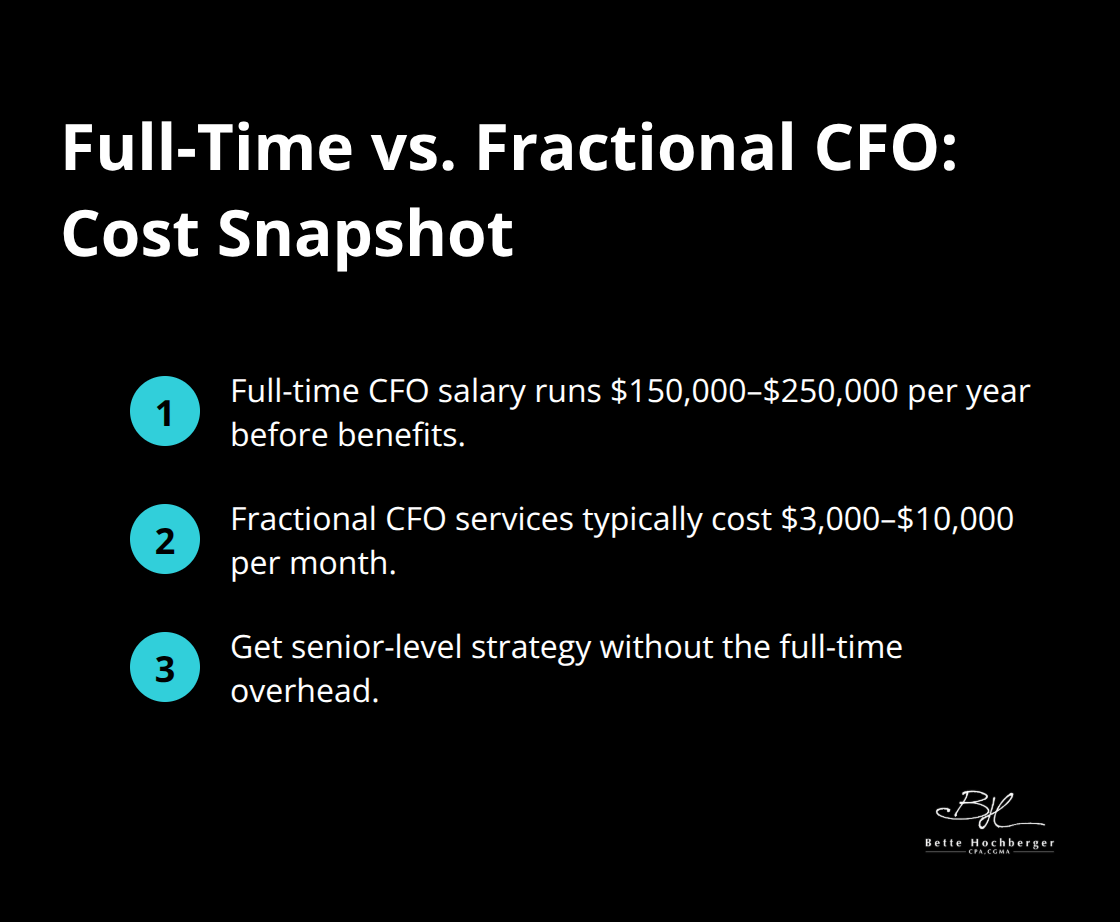
A fractional CFO delivers senior-level financial expertise on a part-time basis at a typical cost of $3,000 to $10,000 monthly, depending on your stage and complexity. This model lets you access real financial strategy without the burden of a full-time executive.
Cash Flow Visibility Prevents Crisis
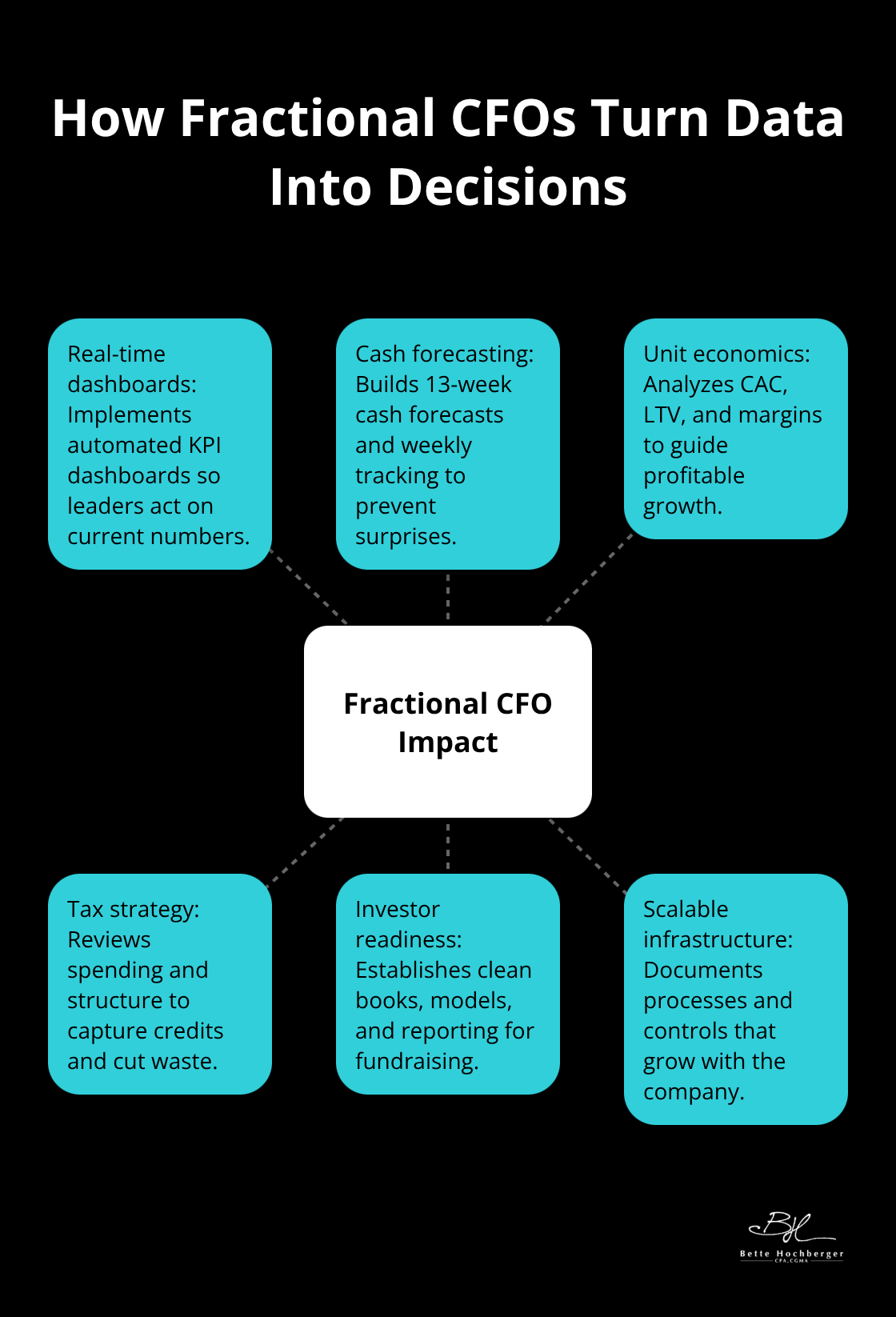
The difference between guesswork and clarity shows up immediately in cash management. Startups without dedicated financial leadership often face cash flow problems only when it’s too late to fix them. A fractional CFO establishes a 13-week cash forecast that shows exactly when you’ll run out of money, enabling you to make decisions about spending, fundraising, or operational adjustments before crisis hits. This visibility transforms reactive scrambling into proactive planning.
Building Investor-Ready Financial Infrastructure
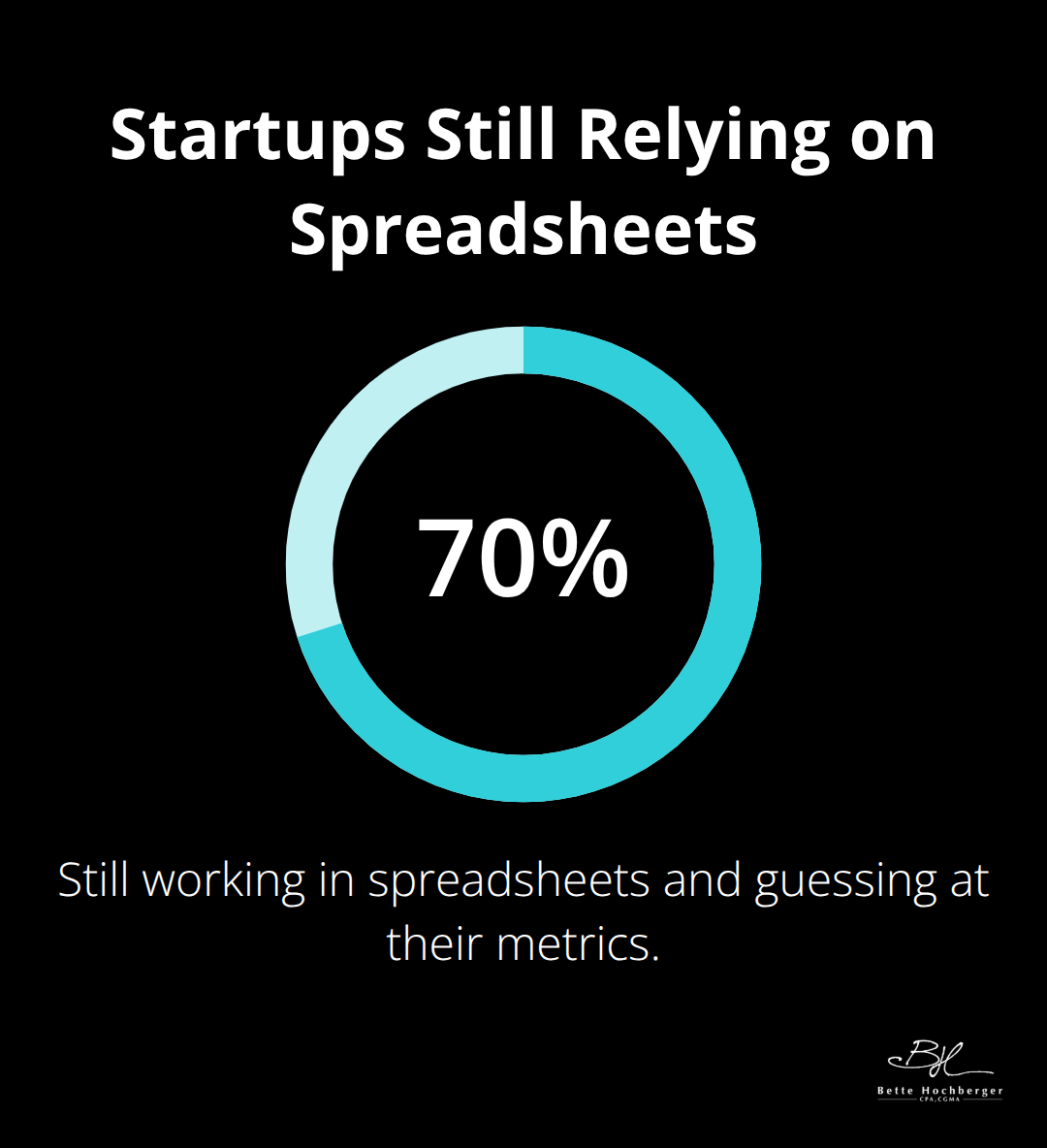
A fractional CFO builds the financial infrastructure that investors expect. When you approach a funding round, having clean books, a credible financial model, and realistic KPI dashboards separates you from 70% of startups still working in spreadsheets and guessing at their metrics. Investors notice the difference immediately.
Scaling Financial Support With Your Growth
The fractional model scales with your growth. At pre-seed, you need help with financial planning and runway projections. At Series A, your needs expand to include budgeting discipline, cost optimization, and investor reporting. At Series B and beyond, the focus shifts to M&A readiness and strategic decision support. Rather than hiring and then replacing executives as your needs change, a fractional CFO adapts the scope of work to match your stage.
Why Early Decisions Matter
Financial complexity doesn’t arrive gradually-it compounds. Early decisions about revenue recognition, cost structure, and cash reserves create ripple effects that compound into either strength or weakness by year two or three. This is why the mistakes startups make without financial expertise carry such weight.
How Fractional CFOs Turn Financial Data Into Growth Decisions
Real-Time Insights Replace Assumptions
A fractional CFO shows you what’s coming next month and what it costs, not just what happened last month. This distinction matters enormously when you’re deciding whether to hire, expand, or pivot. Real-time financial insights mean you stop operating on assumptions and start making decisions backed by actual numbers. When you track metrics like customer acquisition cost, lifetime value, and burn rate weekly instead of quarterly, you catch problems early and spot opportunities faster. A fractional CFO implements dashboards that surface these KPIs automatically, eliminating the manual spreadsheet work that consumes founder time.
Unit Economics Drive Profitable Growth
Most startups track revenue and expenses. The best ones track unit economics-what each customer actually costs to acquire and how much profit they generate over their lifetime. This distinction separates companies that grow profitably from those that scale into insolvency. You understand exactly which customer segments drive real profit and which ones drain cash despite appearing successful on a top-line revenue report.
Tax Strategy Works Year-Round, Not Just in April
Tax strategy and cost optimization happen continuously, not once a year during tax season. A fractional CFO reviews your actual spending patterns and identifies structural inefficiencies that drain cash without adding value. If your payroll taxes, contractor costs, or equipment purchases aren’t optimized for your entity structure, you’re leaving money on the table every single month. This isn’t theoretical-a startup paying contractor invoices without considering 1099 thresholds or S-corp elections typically wastes 15-25% of what they could retain. Similarly, startups often fail to track and claim legitimate R&D tax credits or equipment depreciation that directly reduce taxable income.
Financial Infrastructure Scales With Your Business
A fractional CFO builds the financial infrastructure that scales (clean accounting systems, documented processes, and controls that grow with you). When you reach Series B or approach acquisition, your books need to withstand investor scrutiny. Fractional CFOs establish these foundations early so your growth isn’t constrained by messy financial records or missing documentation. The cost of fixing financial chaos after the fact always exceeds the cost of building it correctly from the start. This foundation becomes your competitive advantage when investors evaluate your readiness for the next stage.
What Happens When Startups Ignore Financial Planning
Startups without dedicated financial leadership operate in a fog. They track revenue in one spreadsheet, expenses in another, and cash in their heads. When the founder finally checks the bank balance at month-end, they discover the company has burned through three months of runway without knowing it. This isn’t carelessness-it’s the natural result of scaling without financial systems. A startup with $500,000 in annual revenue can survive on intuition. A startup hitting $2 million cannot. The transition from guesswork to managed finance doesn’t happen automatically, and founders who delay it pay the price in missed opportunities and preventable crises.
Cash Flow Blindness Kills Faster Than You Think
The number one reason startups fail isn’t lack of revenue-it’s lack of cash. A company can be profitable on paper while running out of money because customers pay in 60 days but vendors demand payment in 30. A startup that doesn’t forecast this gap will eventually face payroll that bounces. Without a rolling cash forecast, founders react to cash problems after they appear, which means cutting spending mid-quarter, delaying hiring, or scrambling for emergency funding at terrible terms. A fractional CFO establishes weekly cash tracking and forward projections that surface these gaps months ahead, not days before disaster. Startups that implement 13-week cash forecasting and update it weekly catch these patterns early enough to adjust spending, accelerate collections, or plan fundraising with actual numbers instead of panic.
Tax Planning Happens Once a Year for Unprepared Startups
Most founders view taxes as an April problem. They file returns, pay what they owe, and move on. In reality, the decisions made in January through December determine what you owe in April. A startup that structures contractor payments without considering 1099 thresholds, fails to elect S-corp status when it becomes advantageous, or doesn’t track eligible R&D spending leaves thousands on the table every single year. A founder paying 25% of revenue in payroll taxes because they didn’t evaluate S-corp election savings, or missing equipment depreciation deductions, makes a permanent decision each month that compounds annually. Startups in high-growth mode often qualify for R&D tax credits they never claim because nobody tracked qualifying expenses. The IRS allows retroactive claims for up to three years, but only if your books are clean enough to substantiate them. Without ongoing tax strategy, a startup might discover after-the-fact that they could have saved $40,000 in credits but can’t prove it because documentation sits scattered across email and Slack. A fractional CFO reviews your actual spending patterns quarterly, identifies tax inefficiencies while there’s time to correct them, and ensures you claim every legitimate deduction your structure allows.
Growth Decisions Without Financial Clarity Cost Millions
Startups often make growth decisions based on incomplete data. A founder sees a customer segment producing $500,000 in annual revenue and decides to hire a dedicated sales team to pursue it. Without unit economics analysis, they don’t know that this segment costs $600,000 annually to serve, making each dollar of revenue a loss. They hire aggressively, burn cash faster, and eventually realize the expansion destroyed profitability. A fractional CFO surfaces this reality before the hiring decision happens. They track what each customer acquisition actually costs, how long customers stay, and what profit they generate. This clarity transforms vague growth instincts into specific, measurable decisions. When a founder understands that Segment A has a 3-year lifetime value of $50,000 with $8,000 acquisition cost while Segment B has $120,000 lifetime value with $15,000 acquisition cost, the resource allocation decision becomes obvious. Without this visibility, founders allocate based on intuition, chase the wrong opportunities, and waste months and capital pursuing unprofitable growth.
Final Thoughts
The financial mistakes startups make without expert guidance compound faster than most founders realize. A founder who implements 13-week cash forecasting catches runway problems months ahead instead of days before payroll bounces. A startup that tracks unit economics discovers which customer segments actually generate profit instead of discovering it too late. A business that reviews tax strategy quarterly instead of once yearly claims legitimate deductions and credits that save thousands annually-these differences separate scaling companies from those that fail.
A fractional CFO for startups eliminates the lag between financial problems and their discovery by building clarity from the beginning, when decisions still matter most. The cost argument is straightforward: a full-time CFO demands $150,000 to $250,000 annually before benefits, while fractional CFO services cost $3,000 to $10,000 monthly and scale with your growth. This flexibility means you access senior-level financial expertise without the overhead of a permanent executive, whether you need pre-seed planning, Series A budgeting, or Series B M&A readiness.
The right financial partner accelerates your success by replacing guesswork with clarity. We at Bette Hochberger, CPA, CGMA work with founders to establish the systems, forecasts, and strategic insights that transform financial data into growth decisions. The sooner you bring in this expertise, the sooner your financial decisions start working for you instead of against you.