
Most business owners leave thousands of dollars on the table each year simply because they don’t know which strategic tax moves actually work. The gap between what you’re paying and what you could legally owe is often massive.
We at Bette Hochberger, CPA, CGMA have identified five concrete strategies that consistently reduce tax liability for our clients. This guide walks you through each one with real numbers and actionable steps.
1. Maximize Retirement Contributions as Your First Line of Defense
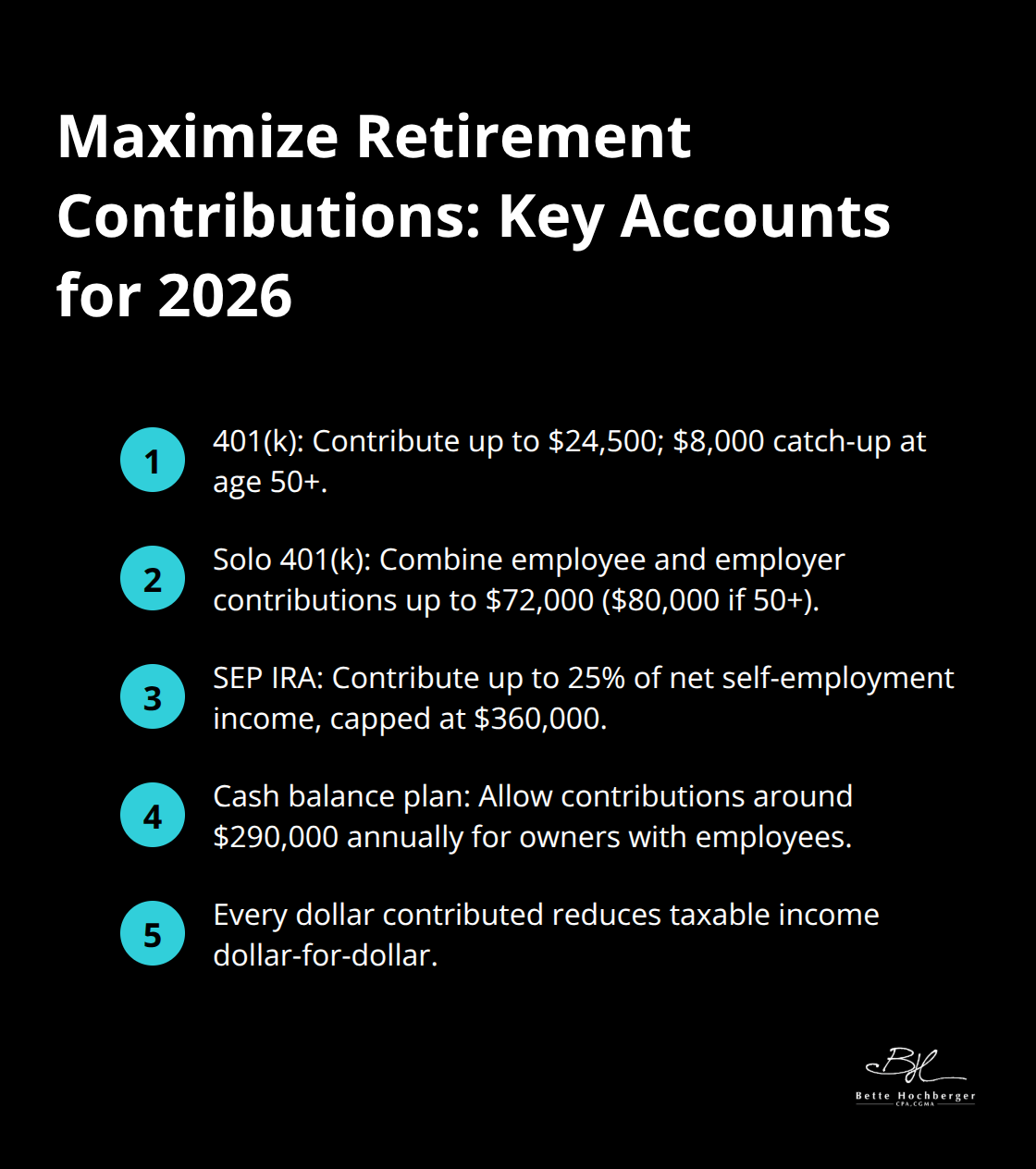
The 2026 401(k) contribution limit reaches $24,500, with an additional $8,000 catch-up for those 50 and older, totaling $32,500 annually. Self-employed workers can contribute to a Solo 401(k) as both employer and employee, potentially reaching $72,000 in total contributions for 2026 ($80,000 if 50+). A SEP IRA allows you to contribute up to 25% of your net self-employment income, capped at $360,000, making it ideal for solo practitioners with high earnings. For business owners with employees, a cash balance plan accepts contributions around $290,000 annually, though you must offer the same benefits to all eligible staff. Every dollar you contribute reduces your taxable income dollar-for-dollar, meaning a $24,500 contribution in the 37% federal bracket saves approximately $9,065 in federal taxes alone.
Timing creates immediate tax relief. Contributions to traditional 401(k)s and SEP IRAs must reach the account by December 31, while Solo 401(k) contributions can extend until your tax filing deadline if you file an extension. If you’ve already earned substantial income this year, maxing out these accounts immediately should become your priority because the tax savings compound. Many business owners overlook the catch-up provisions available after age 50, leaving free tax deductions unused. The tax-deferred growth inside these accounts means your money compounds without annual tax drag, amplifying your wealth over decades-and this foundation positions you perfectly to explore how your business structure itself can multiply these savings even further.
2. Your Business Structure Determines Your Tax Bill
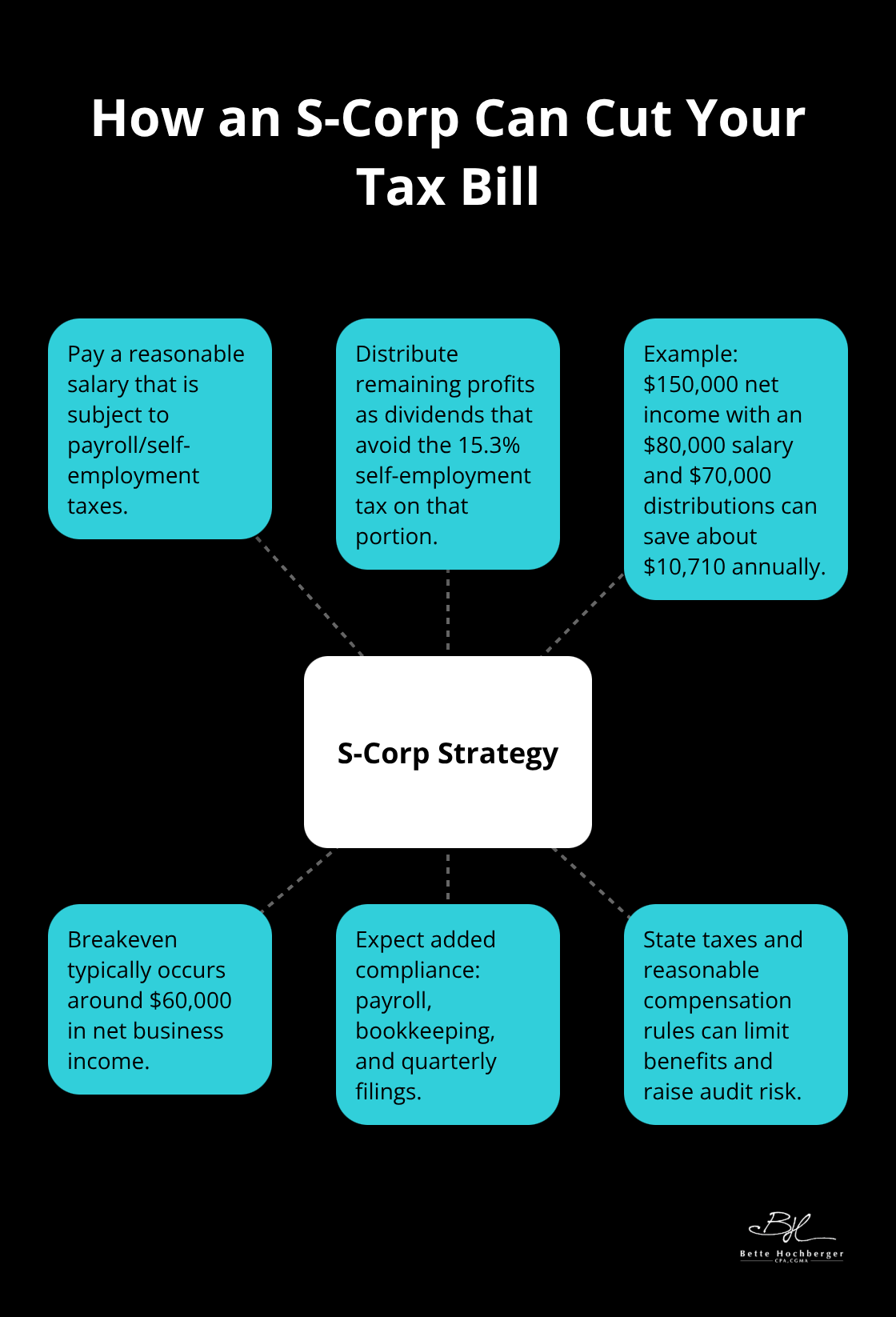
How you organize your business matters far more than most owners realize. An S-Corp election for self-employment tax savings can save you thousands annually compared to a standard LLC taxed as a sole proprietorship, particularly if you earn between $60,000 and $200,000 in net profit. The mechanism works like this: an S-Corp requires you to take a reasonable salary subject to self-employment taxes, then you distribute remaining profits as dividends that avoid the 15.3% self-employment tax on that portion. A business generating $150,000 in net income might pay yourself an $80,000 salary and take $70,000 in distributions, saving approximately $10,710 in self-employment taxes annually. The trade-off involves additional accounting complexity and quarterly filings, so the tax savings must exceed the extra compliance costs-typically this breakeven occurs around $60,000 in net business income.
State tax implications shift dramatically based on your entity choice. Some states impose franchise taxes or entity-level income taxes that eliminate the S-Corp advantage entirely, while others like Texas, Florida, and Nevada impose no state income tax, making an S-Corp election even more valuable. Passive income splitting through multiple entities can work for real estate investors or those with rental operations, but the IRS scrutinizes aggressive structures closely, and improper implementation triggers audit risk.
Your reasonable salary requirement exists precisely because the IRS targets owners who pay themselves minimal salaries while extracting massive distributions. Analyzing your specific income level, state location, and profit distribution patterns reveals whether an S-Corp election makes financial sense for your situation-the wrong choice leaves money on the table, while the right structure implemented correctly generates five-figure annual savings that position you to capture even more through strategic capital loss harvesting.
3. Turn Investment Losses Into Real Tax Savings
Capital losses represent tax gold when you harvest them strategically throughout the year instead of letting them accumulate. When you sell an investment at a loss, that loss offsets capital gains dollar-for-dollar, eliminating tax on those gains entirely. If losses exceed gains, you deduct up to $3,000 of ordinary income in the current year, then carry forward unlimited unused losses to future years. A $15,000 net loss this year lets you deduct $3,000 against your wages or business income now, then use the remaining $12,000 to eliminate capital gains over the next four years. Most investors miss this opportunity because they either fail to track losses or panic-sell in December, missing the chance to plan strategically across twelve months.
Timing your sales controls when gains and losses hit your tax return. If you hold significant capital gains from winning investments, identify underperforming positions in your portfolio and sell them before year-end to offset those gains. The wash-sale rule prevents repurchasing substantially identical securities within 30 days before or after the sale, or the loss gets disallowed and added to the new purchase’s cost basis instead. You can replace a losing stock with a similar but not identical alternative within days and maintain your desired exposure while locking in the tax loss-selling Apple shares at a loss then buying a technology ETF or different tech stock avoids the wash-sale trap completely. Carrying forward losses to future years provides a permanent tax benefit, so even if you don’t need a $3,000 deduction today, that loss shields gains you’ll realize next year or beyond, setting the stage for how you claim every deductible business expense that most owners overlook entirely.
4. Stop Leaving Money on the Table With Overlooked Deductions
Most business owners claim only 40% of the deductions they’re legally entitled to, which means you’re likely overpaying your taxes significantly. Home office deductions work on two methods: the simplified approach allows $5 per square foot up to 300 square feet (maximum $1,500 annually), while the actual expense method captures rent, utilities, insurance, and depreciation on your dedicated workspace.
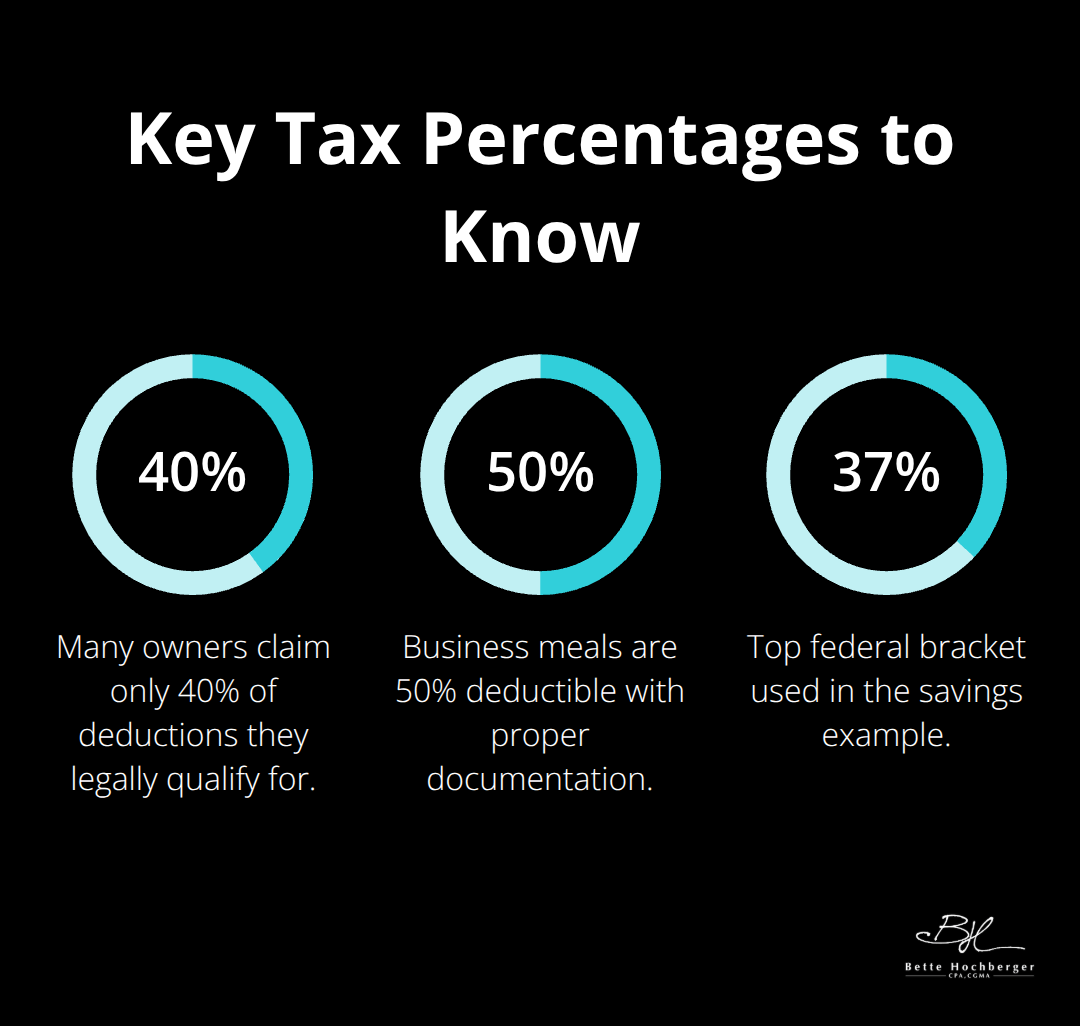
Vehicle expenses follow the same dual approach-either use the standard mileage rate (76 cents per mile for the first half of 2026) or track actual costs like fuel, maintenance, and insurance, though the mileage method typically delivers larger deductions for most owners. Meal expenses for business purposes are 50% deductible when you document who attended, what business was discussed, and the restaurant name and date; solo meals while traveling for business qualify, but meals with clients or employees require contemporaneous notes to survive IRS scrutiny. Professional development, software subscriptions, and equipment purchases all qualify as current-year deductions if they relate directly to your business operations, meaning your accounting software, industry certifications, and tools purchased this year reduce your taxable income immediately rather than being capitalized over years.
Documentation determines whether the IRS accepts or denies your deductions when audited. Quarterly record-keeping prevents the December scramble where you estimate expenses and lose credibility with the IRS during examination. Maintain receipts, bank statements, and mileage logs throughout the year rather than reconstructing them months later when memory fades and details disappear. The IRS targets businesses with unusually high deduction ratios relative to industry norms, so claiming legitimate expenses proportionate to your revenue makes audits less likely. Photograph receipts, use expense-tracking apps for mileage, and categorize charges monthly into spreadsheets organized by deduction type-this approach captures thousands in legitimate deductions most owners miss while creating the documentation trail that transforms audits from threats into straightforward confirmations of your actual business expenses, positioning you to time income recognition strategically and defer tax liability across multiple years.
5. Time Income Recognition and Defer Tax Liability
Most business owners treat income timing as passive-they invoice when work completes and deposit checks when they arrive. This approach costs thousands annually in unnecessary taxes. Strategic income timing means projecting your year-end tax bracket in November, then deciding whether you accelerate invoices into December or defer them to January based on where you’ll land. If you approach the 37% federal bracket threshold, deferring $50,000 in client invoices to next year saves $18,500 in federal taxes alone, assuming you drop into a lower bracket. Conversely, if you stay well below your bracket ceiling, accelerating year-end invoices locks in current-year deductions against that income while keeping you in the same tax bracket.
Prepaid expenses function as legal income deferrals when you structure them correctly. The general rule is that you can’t prepay business expenses for a future year and deduct them from the current year’s taxes. Installment sales for asset dispositions deserve attention too-selling business equipment or real estate on an installment plan spreads the gain across multiple years rather than concentrating it in one, potentially keeping you in lower brackets longer. Timing client invoices matters equally; instead of sending invoices December 31st that clients won’t pay until February, send them January 2nd and recognize the income when cash arrives, moving the tax event into next year when you can plan bracket positioning more strategically.
The mechanics of income deferral require honest projections by late October-not guesses, but actual numbers from your accounting records showing year-to-date revenue and anticipated final quarter activity. This foundation positions you to explore how professional guidance transforms these individual moves into a coordinated strategy that multiplies your tax savings across multiple years.
Final Thoughts
These strategic tax moves produce real results only when you act on them. The difference between understanding a strategy and executing it determines whether you save $5,000 or $50,000 annually, and most business owners read tax advice, nod along, then return to their old patterns because they lack a structured plan and professional accountability. Annual tax planning beats reactive year-end scrambles by months-when you work with a tax professional in March or April, you have nine months to adjust your business structure, time income strategically, and position your investments for optimal tax outcomes.
We at Bette Hochberger, CPA, CGMA help business owners and professionals implement these strategic tax moves within a coordinated framework tailored to your specific situation. Rather than treating each strategy in isolation, we analyze your complete financial picture to identify which moves deliver the highest returns for your circumstances. Our strategic tax planning and fractional CFO services ensure you capture deductions you’d otherwise miss while avoiding aggressive positions that trigger audit risk.
Tax law changes annually, and staying informed requires more than reading articles-the 2026 contribution limits differ from 2025, state tax implications shift when you relocate, and new legislation alters depreciation rules or charitable giving strategies. Professional guidance keeps you current without requiring you to monitor IRS publications constantly. The question is whether you’ll implement these strategies this year or continue leaving thousands on the table while your competitors capture these savings.