
Many growing businesses struggle with financial oversight but can’t justify hiring a full-time CFO. External financial oversight through fractional CFOs offers a practical solution that strengthens governance without the overhead.
At Bette Hochberger, CPA, CGMA, we’ve seen firsthand how this model transforms financial management for companies at every stage. This guide walks you through what fractional CFOs do, why they matter, and how to implement one effectively.
What Fractional CFOs Actually Do
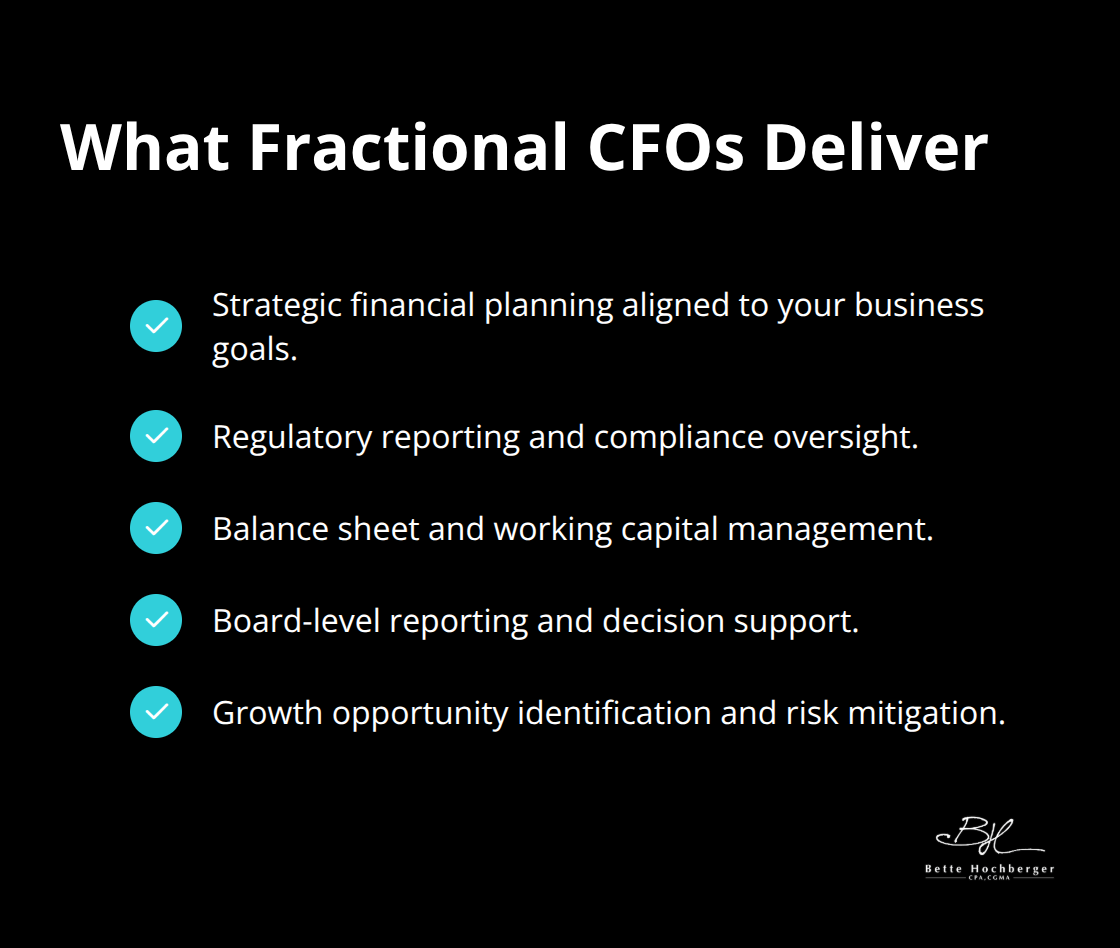
A fractional CFO works part-time or on-demand to provide high-level financial leadership without the $150,000–$250,000 annual salary of a full-time executive. This role handles strategic financial planning, regulatory reporting, balance sheet management, and board-level insights tailored to your business stage and goals. Unlike a controller who manages day-to-day accounting, a fractional CFO shapes financial strategy, identifies growth opportunities, and mitigates risk. They typically engage 10–30 hours per month, scaling up or down based on your needs, making them ideal for companies that need sophisticated financial guidance but lack the revenue to justify a permanent hire.
The Real Difference from Full-Time CFOs
A full-time CFO commands significant overhead and often brings rigid processes designed for large organizations. Fractional CFOs operate differently because they work across multiple clients and industries simultaneously, which means they bring fresh perspectives and battle-tested solutions from comparable businesses. A full-time CFO might take months to implement a new reporting system; a fractional CFO moves faster because they’ve already solved similar problems elsewhere. The cost advantage is substantial-you pay only for the expertise you need rather than funding salary, benefits, and overhead. This model also eliminates the risk of hiring the wrong person for a permanent role; you can test the relationship and expand or contract the engagement without severance or recruitment delays.
Who Actually Benefits Most
Tech and SaaS companies use fractional CFOs to navigate fundraising, investor reporting, and cash-flow optimization during hypergrowth phases. Real estate firms and property management companies benefit from asset-liability management and regulatory compliance oversight. Professional services firms, law practices, and consulting shops gain strategic financial planning that directly impacts partner profitability and firm valuation. Credit unions and financial institutions rely on fractional CFOs for NCUA 5200 reporting accuracy and regulatory compliance that full-time staff sometimes miss due to competing priorities. Growth-stage companies in transition-whether managing system implementations, restructuring operations, or preparing for acquisition-use fractional CFOs as stabilizing forces who maintain financial continuity without permanent commitments. The sweet spot is typically companies with $2 million to $50 million in revenue where financial complexity outpaces internal capacity but hiring a full-time CFO remains premature.
What This Means for Your Next Steps
Understanding which fractional CFO model fits your business sets the stage for defining clear expectations and integrating this expertise into your existing team structure.
Why Fractional CFOs Deliver Real Financial Impact
Cost Efficiency That Frees Your Team
Fractional CFOs eliminate the salary burden of a full-time executive while delivering strategic output that internal staff cannot produce alone. Companies with full-time CFOs often watch those executives spend their days managing spreadsheets, reconciling accounts, and responding to compliance demands instead of shaping financial strategy. A fractional CFO handles those operational bottlenecks, which frees your internal team to focus on execution. Your controller spends less time chasing missing documentation and more time closing books faster. Clients have reduced their close timeline from 15 days to 8 days simply by having a fractional CFO streamline reporting processes and identify redundant workflows.
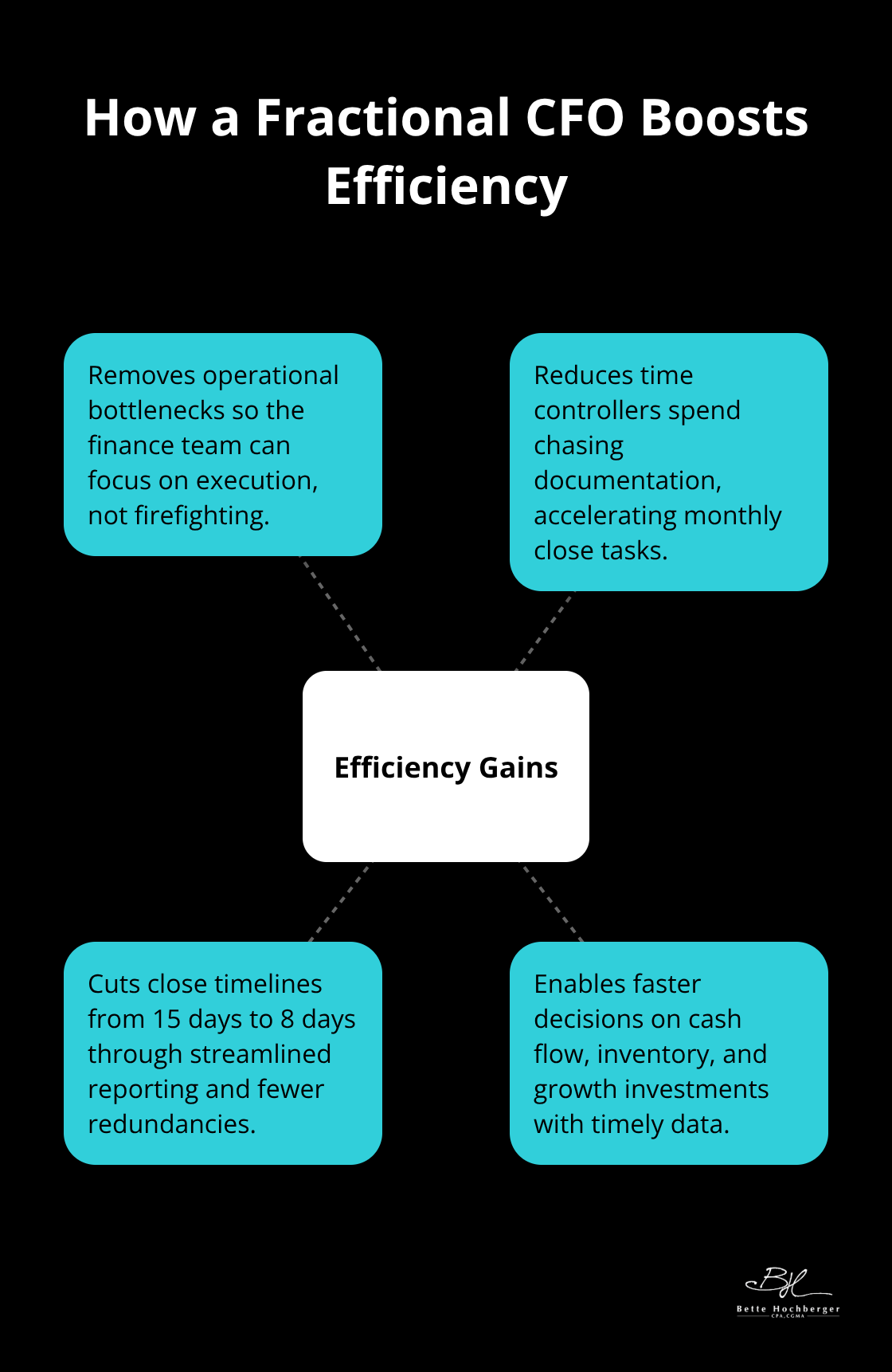
That acceleration matters because faster closes mean faster decision-making on cash flow, inventory, and growth investments.
Strategic Planning That Transforms Operations
Fractional CFOs separate themselves from outsourced bookkeeping services through active balance sheet management and working capital optimization. A fractional CFO analyzes your balance sheet monthly, flags inefficiencies, and recommends specific actions-like tightening accounts receivable collection or renegotiating payment terms with vendors. Real estate firms have reduced their days sales outstanding (DSO) from 45 days to 32 days within six months, recovering cash that was sitting idle in customer invoices. Tech companies benefit from fractional CFOs who build unit economics dashboards tracking customer acquisition cost relative to lifetime value, metrics that directly influence fundraising conversations and investor confidence.
Profitability Insights by Business Segment
Professional services firms gain monthly profitability analysis by practice area or client, revealing which engagements are actually profitable after overhead allocation. This data transforms partner compensation discussions from guesswork into fact-based decisions. Partners no longer argue about which clients drive value; the numbers show exactly which engagements generate margin and which ones drain resources. A fractional CFO applies this same rigor across industries, identifying the specific levers that move profitability in your business model.
Flexibility Without the Hiring Risk
A fractional CFO engagement typically starts at 15 hours monthly, allowing you to assess fit before expanding the relationship. If the fit isn’t right, you exit cleanly without severance negotiations or recruitment delays. The cost structure itself is flexible-when your business enters a quiet period, you scale back hours. When you manage a system implementation or acquisition, you increase the engagement. Full-time CFOs don’t offer that flexibility without creating awkward conversations about reduced responsibilities or layoffs. This scalability means you pay only for the expertise you need at each stage of growth.
Building Institutional Knowledge
A fractional CFO mentors your existing finance team on data management, analytics, and reporting best practices, raising overall financial literacy within your organization. This investment in your staff creates institutional knowledge that outlasts the engagement itself. Your team learns not just how to execute tasks but why certain financial decisions matter and how to think strategically about numbers. When your business reaches the stage where a full-time CFO makes sense, your internal team already understands the frameworks and discipline that fractional CFOs bring. This preparation positions you to hire a full-time CFO who can hit the ground running rather than spending months teaching basic financial governance.
Getting Your Fractional CFO Relationship Right From Day One
Define Success in Concrete Terms
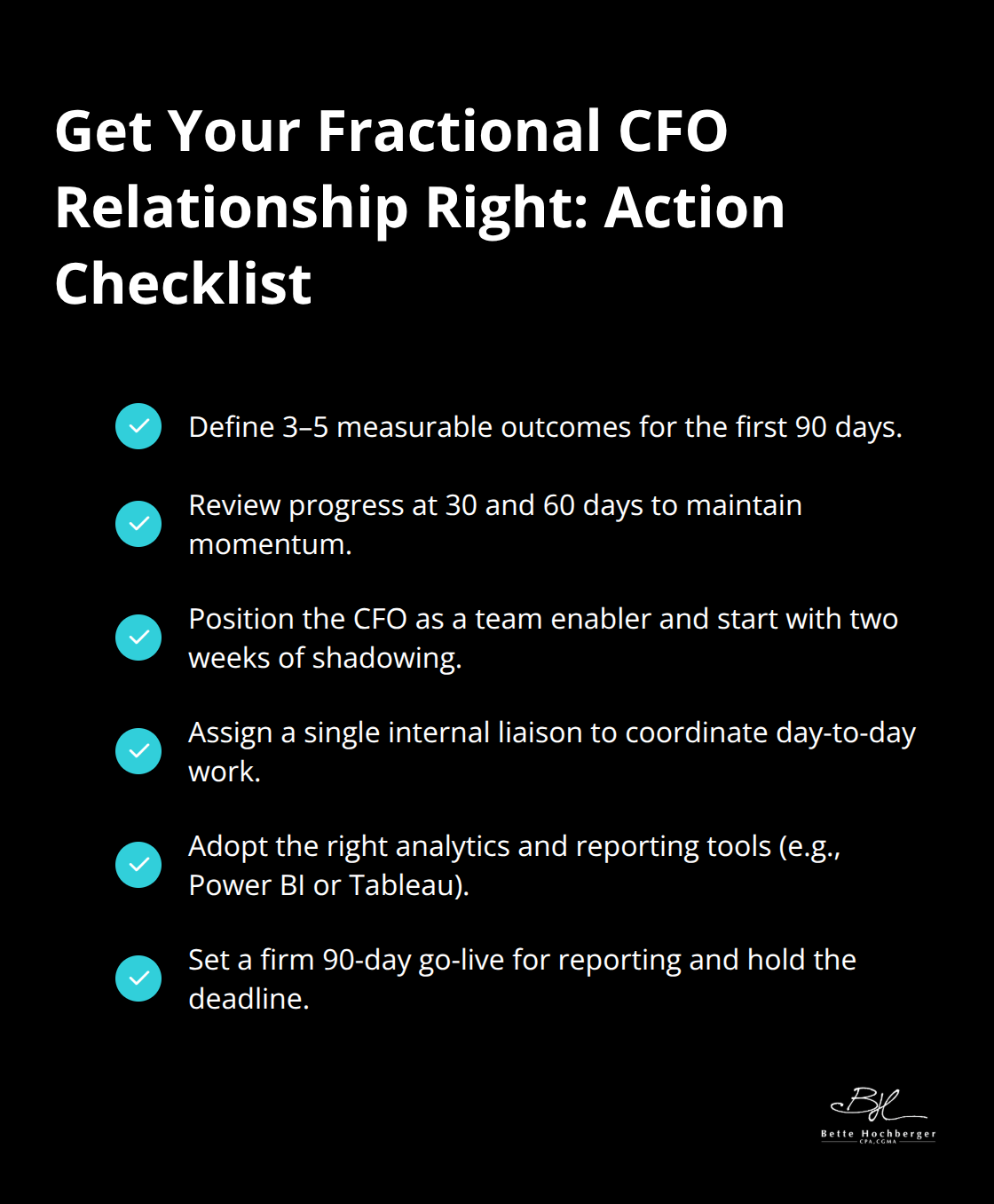
The difference between a fractional CFO engagement that transforms your financial operations and one that disappoints often comes down to how clearly you define success upfront. Start by identifying three to five specific financial outcomes you want to achieve in the first 90 days. These should be concrete and measurable-reduce your close timeline from 12 days to 8 days, identify $200,000 in working capital improvements, build a monthly cash flow forecast that your team actually uses, or establish board reporting that takes 4 hours instead of 20. Vague objectives like “improve financial management” guarantee misalignment. Your fractional CFO needs to know exactly what success looks like so they can prioritize ruthlessly rather than spreading effort across ten different initiatives.
Many businesses assess whether the engagement is working too late. At 30 days, you should see movement on at least one of your priority outcomes. At 60 days, you should see clear progress on most of them. This aggressive early timeline forces both sides to focus and prevents the engagement from drifting into perpetual planning mode.
Position Your Fractional CFO as a Team Enabler
Integration into your existing team matters more than most businesses realize. Your fractional CFO cannot succeed if your controller, accounting manager, or bookkeeper views them as a threat or an auditor policing their work. Position the fractional CFO explicitly as someone who makes your existing team’s job easier and more strategic, not someone who replaces them. Have your fractional CFO spend the first two weeks shadowing your current processes without making changes, then schedule a joint meeting where they present specific workflow improvements that reduce manual work for your staff. When your team sees that a fractional CFO eliminates tedious reconciliations or automates redundant reporting tasks, resistance evaporates.
Assign one internal person as the primary liaison-typically your controller or finance manager-who owns the day-to-day coordination. This prevents decision-making from fragmenting across multiple staff members and keeps communication clean.
Invest in the Right Technology Tools
Stop pretending your current tools are adequate if they’re not. Many businesses run on spreadsheets because they never invested in proper accounting software or reporting tools. A fractional CFO typically recommends platforms like Power BI or Tableau for dashboards, which integrate with most accounting systems and eliminate manual data entry. These tools cost between $500 and $2,000 monthly depending on complexity, a fraction of what you’ll recoup from faster reporting and better decision-making.
The fractional CFO should own the technology selection and implementation timeline, not delegate it back to you. They’ve implemented these systems dozens of times and know exactly which tool matches your business size and complexity. Set a firm go-live date for new reporting tools-90 days is reasonable for most implementations-and hold that deadline. Delayed implementations signal that this work isn’t a priority, which undermines the entire engagement and wastes the fractional CFO’s early momentum.
Final Thoughts
Fractional CFOs solve a real problem that growing businesses face: the need for sophisticated financial leadership without the permanent cost and commitment of a full-time executive. External financial oversight through this model delivers measurable results-faster close timelines, better cash flow management, strategic insights that drive profitability, and governance that actually works. The businesses that benefit most are those honest about their current financial gaps and willing to invest in expertise that transforms how they operate.
What makes fractional CFOs effective is their ability to work across your existing team rather than replace it. They mentor your staff, implement systems that stick, and leave behind institutional knowledge that outlasts the engagement. Your controller becomes more strategic, your accounting processes accelerate, and your board receives reporting that informs decisions instead of burying them in spreadsheets.
If your business has outgrown your current financial capabilities but isn’t ready for a full-time CFO, a fractional engagement is worth exploring. We at Bette Hochberger, CPA, CGMA specialize in fractional CFO services designed to strengthen financial governance and support sustainable growth. The conversation starts with understanding where your business stands today and what financial outcomes matter most to your success.