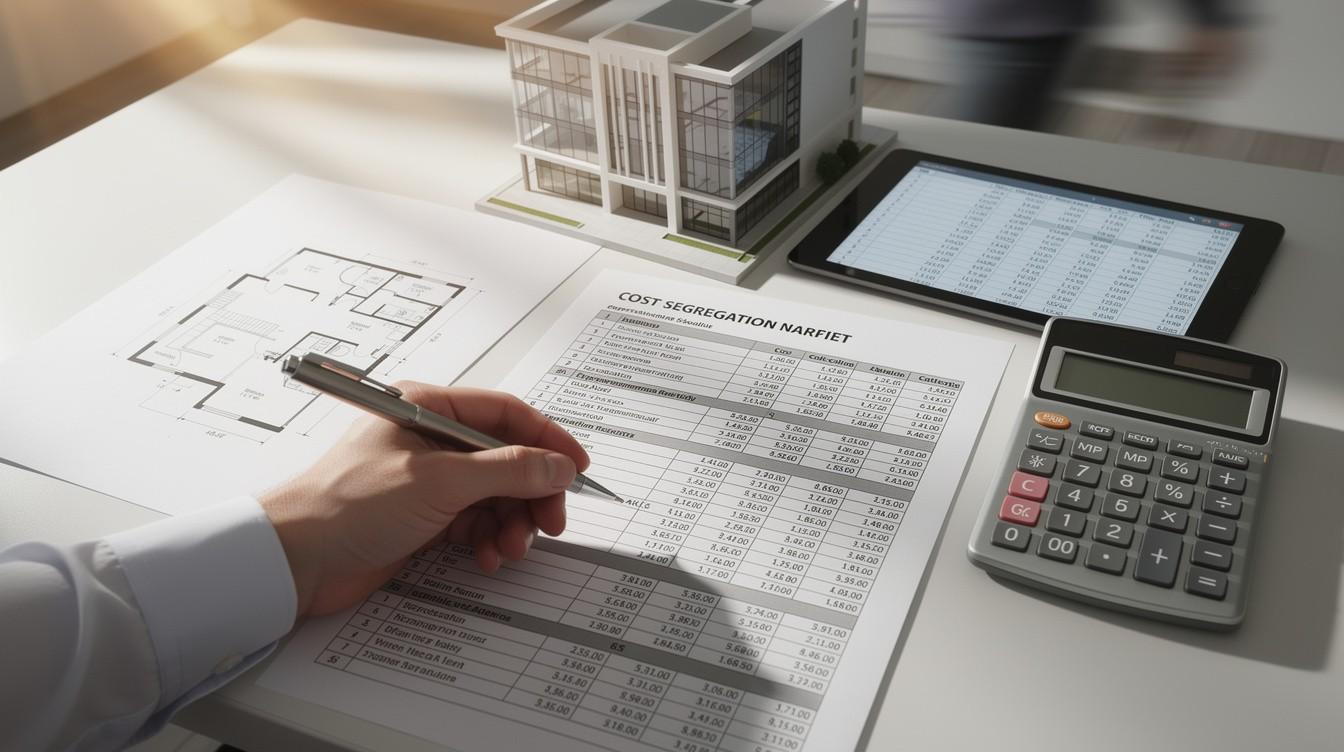
Real estate owners often miss significant tax savings because they don’t realize how their property’s components depreciate at different rates. Cost segregation studies unlock a powerful strategy that reclassifies building components into shorter depreciation periods, generating substantial deductions.
At Bette Hochberger, CPA, CGMA, we’ve seen investors recover hundreds of thousands in tax benefits through this approach. This guide walks you through how cost segregation works and whether your property qualifies.
How Cost Segregation Reclassifies Your Property’s Depreciation
Cost segregation takes a property’s total cost and breaks it into specific components that depreciate at different rates than the building as a whole. Standard depreciation treats residential properties as a single asset depreciating over 27.5 years and commercial properties over 39 years. Cost segregation identifies portions of that property-carpeting, lighting fixtures, cabinetry, plumbing systems, and tenant improvements-that qualify for 5-year, 7-year, or 15-year depreciation schedules instead.
This reclassification doesn’t create new deductions; it repositions existing depreciation to earlier years where it generates immediate tax savings. A typical commercial building allocates roughly 20 to 40 percent of its total cost into these shorter-lived categories, which means substantially larger deductions in years one through five. The IRS recognizes this approach through its Cost Segregation Audit Techniques Guide, which outlines the methodology and documentation standards required to withstand scrutiny.
The Engineering and Tax Review Process
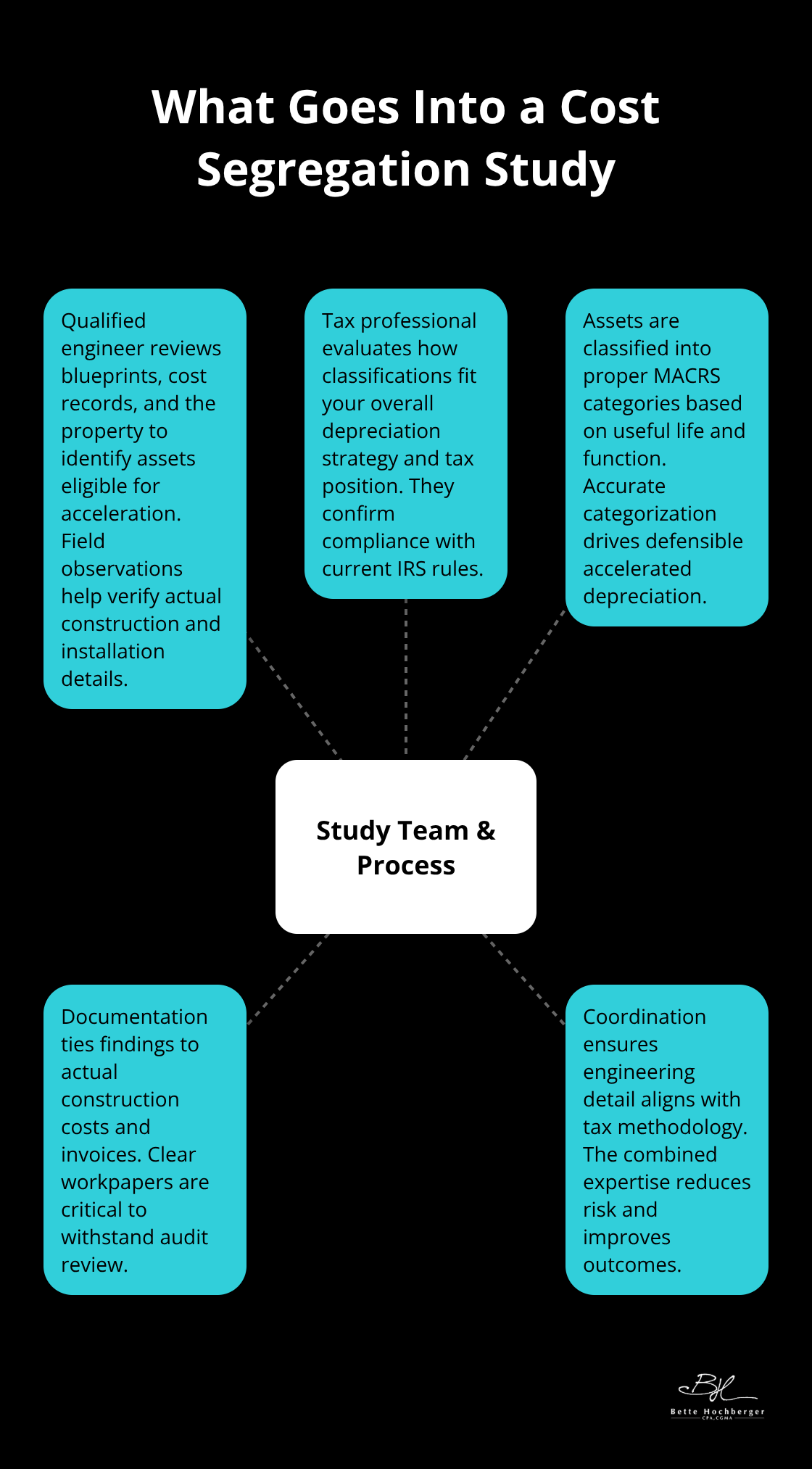
The process requires a qualified engineer and tax professional to review blueprints, cost records, and the property itself to identify which components qualify for accelerated treatment. This combination of expertise matters because the study must reflect actual construction costs and component lives to hold up under audit review. The engineer classifies assets into their proper MACRS categories, while the tax professional ensures the findings align with your overall depreciation strategy and tax position.
Strategic Timing for Maximum Deductions
The ideal timing to perform a cost segregation study occurs during the year you purchase, construct, or substantially renovate the property. Waiting five years means missing years of accelerated deductions that could have generated significant cash flow. If you’ve already owned a property for several years, you can still file a Form 3115 with the IRS to implement a change in accounting method and claim catch-up depreciation for prior years without amending those returns.
Bonus Depreciation and Current Law Changes
The bonus depreciation landscape influences timing significantly. 100 percent bonus depreciation for eligible assets placed in service after January 19, 2025 allows immediate expensing of qualifying short-lived components. In 2024, the rate was 60 percent; it was scheduled to decline further before this legislation changed course. Properties placed in service before January 19, 2025 follow the previous phase-down schedule, so consulting a tax advisor about your specific acquisition or construction date determines which depreciation rules apply.
Cost Justification and Property Thresholds
For properties exceeding $1.5 million in acquisition or renovation cost, the tax savings typically justify the upfront cost of the study, which ranges from several thousand dollars depending on property complexity. The financial benefit compounds when bonus depreciation applies, as the combination of accelerated depreciation and immediate expensing can generate six-figure tax savings in the first year alone. Understanding whether your property qualifies and which depreciation rules govern your situation sets the foundation for identifying which real estate assets benefit most from this strategy.
How Cost Segregation Generates Real Cash Flow
Cost segregation’s primary advantage isn’t theoretical-it’s immediate cash in your pocket. When you reclassify 20 to 40 percent of a property’s cost into 5-year, 7-year, and 15-year categories, you pull forward depreciation deductions that would otherwise spread across decades. A $1 million commercial property with $800,000 in depreciable building cost generates roughly $20,513 in first-year depreciation under standard 39-year treatment. The same property analyzed through cost segregation, with $300,000 reclassified to shorter lives, produces approximately $52,106 in first-year depreciation without bonus depreciation-more than doubling your deductions. That difference translates to $11,690 in after-tax savings at a 37 percent tax rate in year one alone.
The Compounding Effect Over Your Holding Period
Over five years, the cumulative impact becomes substantial enough to fund additional acquisitions or pay down debt faster. Bonus depreciation amplifies these results dramatically. Properties placed in service after January 19, 2025 qualify for 100 percent bonus depreciation on eligible assets with useful lives of 20 years or less. The same $1 million property scenario with 60 percent bonus depreciation available in 2024 could generate roughly $72,600 in first-year tax savings-enough to offset the cost of the study within months.
Why Timing Intensifies Your Tax Advantage
Timing matters intensely because a property purchased in January 2025 captures different depreciation rules than one purchased in December 2024. The present value of early-year deductions is substantial because tax dollars saved in year one can be reinvested immediately, compounding returns over your holding period. Properties held five years or longer see the full benefit because depreciation recapture taxes on sale don’t eliminate the cash flow advantage generated during ownership.
Properties That Justify the Study Cost
Properties exceeding $1.5 million in acquisition or renovation cost almost always justify the cost segregation study, which typically ranges from $3,000 to $15,000 depending on complexity. The return on investment routinely exceeds 10 to 1 when bonus depreciation applies. Smaller properties under $1.5 million can still benefit, particularly if they’ve undergone substantial renovations or include significant tenant improvements, but the analysis becomes tighter. A $750,000 residential rental property might generate $8,000 to $12,000 in tax savings, which could justify a $4,000 study cost if you plan to hold the property long-term.
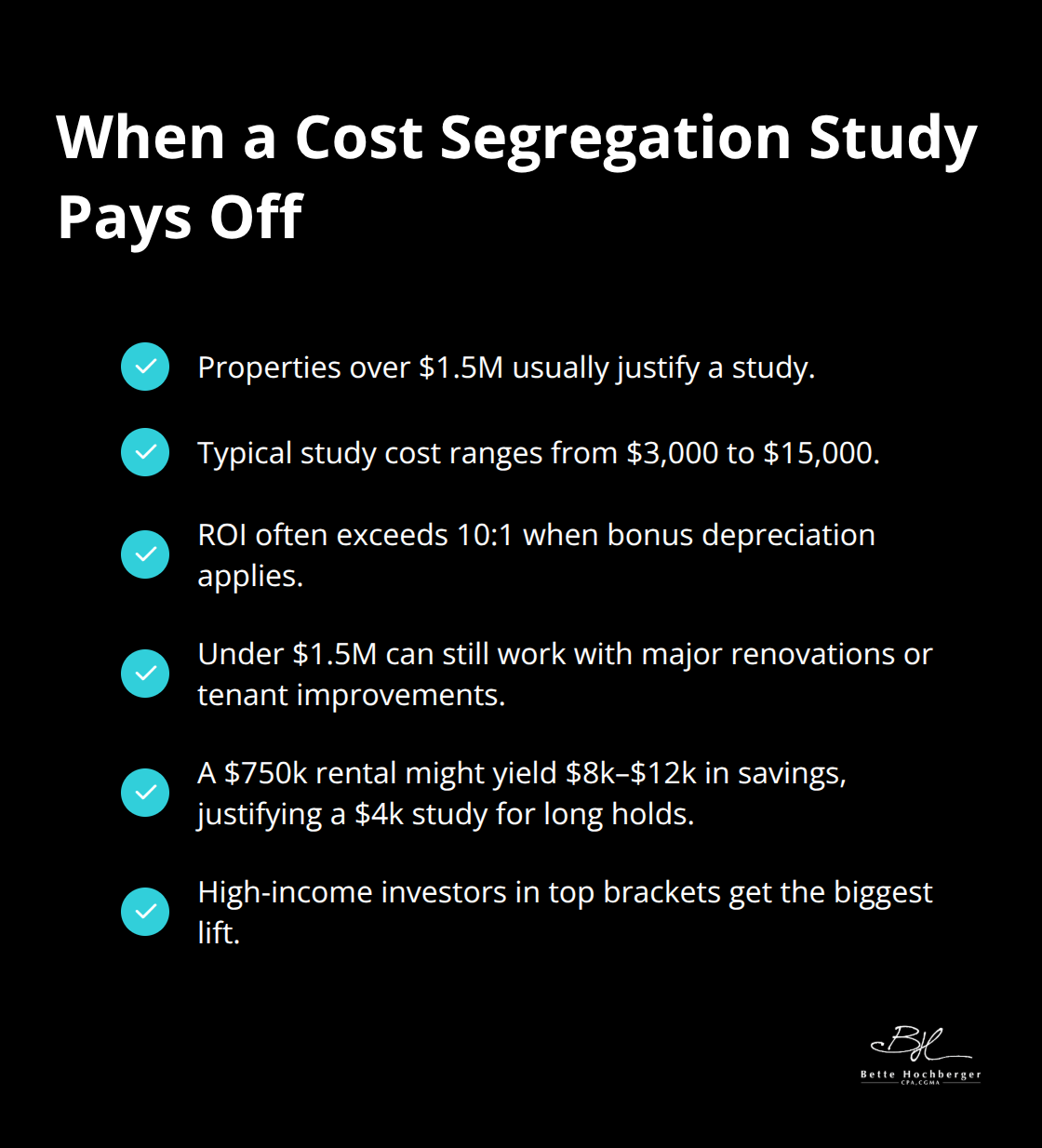
High-income investors in top tax brackets see the greatest benefit because their marginal rate applies to the deductions generated.
Bonus Depreciation as Your Strategic Multiplier
The legislation passed in January 2025 restored 100 percent bonus depreciation for qualified property placed in service after January 19, 2025. This temporary window won’t last forever. Properties placed in service before that date follow the phase-down schedule, where bonus depreciation was 60 percent in 2024 and scheduled to decline to 40 percent in 2025 and 20 percent in 2026 under the previous rules. The difference between 100 percent and 40 percent bonus on a $300,000 pool of reclassified assets is roughly $180,000 in additional first-year deductions.
The number 100% seems to be not appropriate for this chart. Please use a different chart type. That magnitude makes timing your acquisition or construction completion date a legitimate tax-planning decision. Properties under development or in escrow should be positioned to close or reach substantial completion after January 19, 2025 if possible. Existing properties can’t retroactively claim bonus depreciation, but they still benefit significantly from accelerated depreciation on the base property cost even without the bonus component. Understanding which properties qualify and which depreciation rules apply to your situation determines whether cost segregation delivers the tax savings your real estate portfolio needs.
Which Property Types Deliver the Strongest Cost Segregation Returns
Commercial Properties Generate Maximum Acceleration
Commercial properties and mixed-use developments produce the most aggressive cost segregation benefits because they contain substantial quantities of personal property and land improvements that qualify for accelerated depreciation. Office buildings, retail centers, and hotels typically allocate 25 to 35 percent of their total cost to five-year and seven-year assets, compared to residential properties where the percentage runs lower. A $10 million office building might reclassify $2.5 to $3.5 million into shorter lives, producing first-year depreciation deductions exceeding $500,000 when bonus depreciation applies. Mixed-use developments with both commercial and residential components capture dual advantages: the commercial portions receive aggressive acceleration while residential units benefit from the 27.5-year base schedule. Properties with extensive tenant improvements amplify returns further because tenant buildouts, electrical systems dedicated to specific tenants, and specialized fixtures qualify for five-year treatment. The IRS Cost Segregation Audit Techniques Guide recognizes this distinction, making commercial properties the most defensible candidates for aggressive reclassification strategies.
Multifamily and Industrial Properties Hit the Sweet Spot
Multifamily residential buildings and industrial warehouses occupy the sweet spot where cost segregation delivers meaningful cash flow without excessive complexity. Garden-style apartments and mid-rise residential buildings typically allocate 15 to 25 percent of costs to accelerated categories, producing five-figure tax savings in year one even without maximum bonus depreciation. A $5 million residential property with $300,000 in reclassified components produces roughly $45,000 in first-year depreciation acceleration, translating to $16,650 in tax savings at a 37 percent rate. Industrial and warehouse facilities benefit from specialized components: concrete pads, loading dock equipment, inventory systems, and specialized HVAC configurations all qualify for shorter lives. Self-storage facilities represent an underutilized opportunity because their modular construction, individual unit doors, and security systems create substantial five-year and seven-year asset pools.
Cost Thresholds That Justify the Study Investment
Properties exceeding $1.5 million in acquisition cost justify the study investment across all three categories, but commercial and industrial properties with construction costs above $3 million deliver return-on-investment ratios exceeding 15 to 1 when bonus depreciation aligns with the placed-in-service date. Properties under $1.5 million still qualify, particularly when recent renovations or substantial capital improvements occurred, but the analysis requires careful evaluation of holding period and tax bracket to confirm the study produces sufficient savings. A preliminary analysis estimates reclassification percentages specific to your property type and acquisition date before you commit to a full study.
Final Thoughts
Cost segregation studies transform how real estate owners approach depreciation strategy by reclassifying building components into shorter depreciation periods that generate substantial tax savings when you need cash flow most. Properties exceeding $1.5 million in acquisition or renovation cost almost always justify the study investment, particularly when bonus depreciation applies, and even smaller properties benefit if they’ve undergone significant improvements or include substantial tenant buildouts. The timing decision matters intensely because depreciation rules shift based on when your property reaches placed-in-service status-properties acquired after January 19, 2025 qualify for 100 percent bonus depreciation on eligible assets, creating a temporary window for maximum acceleration that represents roughly $180,000 in additional first-year deductions compared to the 40 percent bonus available under previous schedules.
Commercial property, multifamily buildings, industrial facilities, and any real estate that underwent recent renovation all qualify as candidates for cost segregation analysis, with return on investment routinely exceeding 10 to 1 when bonus depreciation aligns with your property’s placed-in-service date. The cumulative tax savings over five years fund additional acquisitions or accelerate debt paydown substantially, even without bonus depreciation applying to your situation. Your next step is to consult with a tax professional who understands both the engineering requirements and the tax implications of cost segregation studies.
We at Bette Hochberger, CPA, CGMA specialize in strategic tax planning for real estate owners and help you identify whether your properties qualify while positioning your acquisitions to capture maximum depreciation benefits. The difference between a generic tax approach and a deliberate cost segregation strategy often amounts to six figures in tax savings over your holding period.