Real estate owners leave thousands of dollars on the table every year by missing legitimate tax deductions. The gap between what you can claim and what you actually claim often comes down to knowing which deductions apply to your situation.
At Bette Hochberger, CPA, CGMA, we’ve helped property owners identify overlooked deductions and implement strategies that reduce their tax burden significantly. This guide covers the deductions you can claim today, advanced strategies for serious investors, and the mistakes that cost owners money.
What Deductions Should Real Estate Owners Actually Claim
Mortgage interest remains the most valuable deduction for property owners, but most miss the nuances that maximize it. You can deduct interest on loans up to $750,000 of principal for mortgages taken after December 15, 2017, which applies to most modern mortgages. One critical mistake happens here: you must itemize deductions on Schedule A to claim mortgage interest at all. The standard deduction does not allow you to deduct these costs.
The SALT Cap Forces Strategic Choices
For 2025, the SALT cap limits all state and local taxes, including property taxes, to $40,000 for single filers and married couples filing jointly. This ceiling forces real estate owners to choose between claiming the full property tax deduction or other state and local tax items. Property tax deductions let you subtract what you paid to state and local governments, but that $40,000 cap requires careful planning when combined with mortgage interest deductions.
Depreciation Powers Rental Property Deductions
If you own rental properties, depreciation becomes your most powerful tool. The IRS allows you to recover the cost of your building and improvements over time through annual depreciation deductions on Form 4562. You start depreciation in the year the property is placed in service and continue claiming it for decades. A $400,000 rental property with a 27.5-year residential depreciation period generates roughly $14,545 in annual deductions before considering any accelerated strategies.
Repairs Versus Improvements Changes Everything
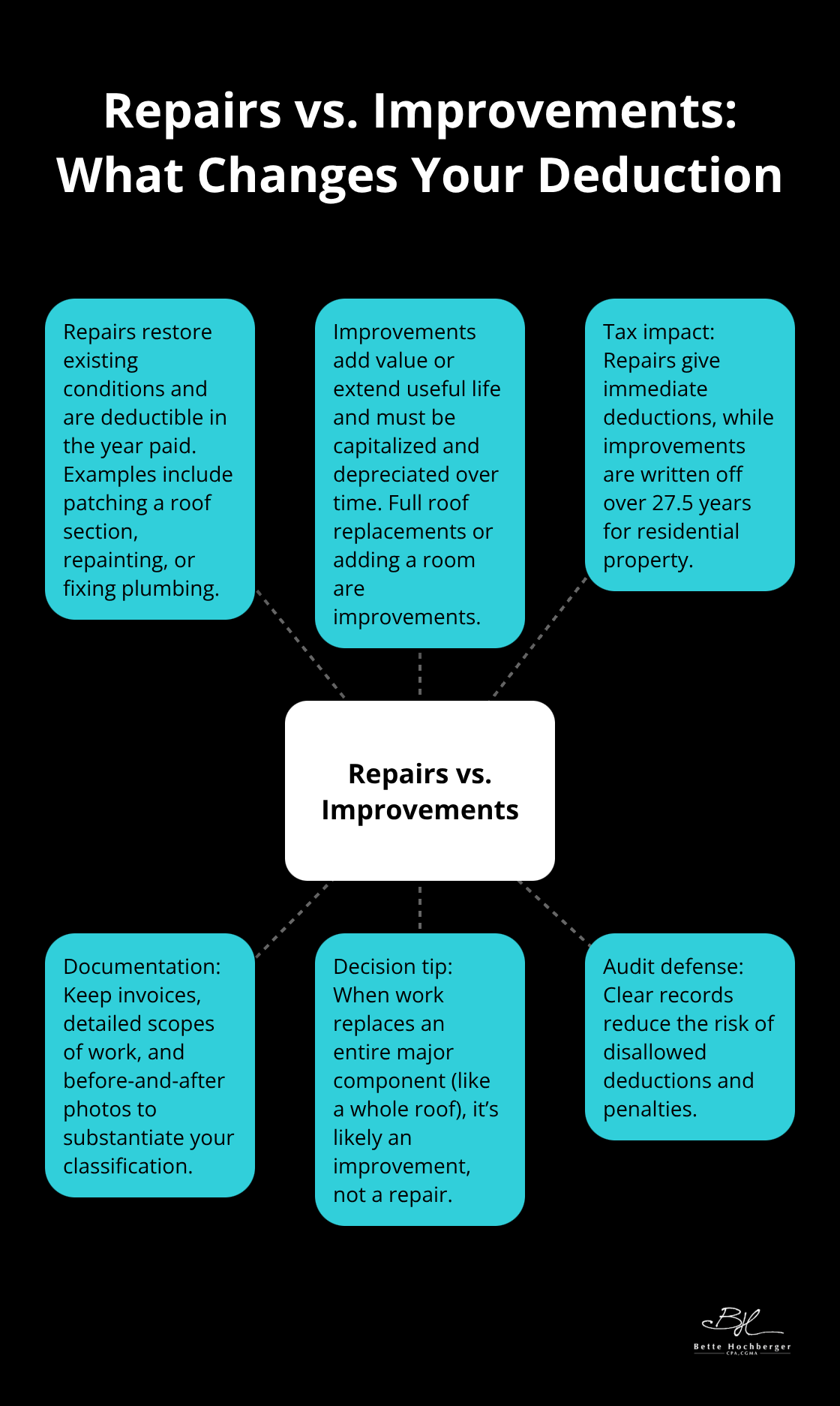
The distinction between repairs and capital improvements determines whether you deduct costs immediately or spread them across years. A repair fixes existing conditions and is deductible in the year you pay for it-replacing a broken roof section, repainting a wall, or fixing plumbing all qualify as repairs. An improvement adds value or extends the property’s useful life and must be capitalized and depreciated. Replacing the entire roof, adding a new room, or installing new flooring counts as an improvement. This distinction matters because misclassifying a $15,000 roof replacement as a repair rather than an improvement gives you an immediate deduction instead of spreading it across 27.5 years.
Professional Fees Reduce Your Taxable Income
Property management and professional fees for accountants, attorneys, and tax professionals directly reduce your rental income on Schedule E. These expenses are deductible in the year you pay them and include fees for preparing rental schedules, managing tenant issues, or filing rental tax returns. Many owners overlook these because they assume professional fees are personal expenses, but when tied to rental activity, they are ordinary and necessary business costs. Keep receipts for every professional service related to your properties and categorize them separately so you do not miss them during tax preparation.
The deductions available to you today form the foundation of your tax strategy, but serious investors accelerate their savings through advanced techniques that go far beyond standard annual deductions.
How Accelerated Depreciation Strategies Cut Years Off Your Tax Timeline
Cost Segregation Reclassifies Property Components Into Faster Deduction Schedules
Cost segregation studies reclassify building costs into shorter-lived property categories, moving assets from the standard 27.5-year residential depreciation timeline into 5, 7, or 15-year buckets. This acceleration matters because you deduct the cost faster and reduce your taxable income in years when you need it most. A $2 million commercial property typically generates 15-25% more depreciation in the first five years through cost segregation compared to standard depreciation alone. The IRS Section 168(k) bonus depreciation rules now allow 100% deduction for qualifying property placed in service between January 19, 2025 and January 1, 2031, meaning you can write off eligible assets in a single year rather than spreading deductions across decades.
The number 100% seems to be not appropriate for this chart. Please use a different chart type.
Section 179 and Bonus Depreciation Stack Together for Maximum Impact
Section 179 expensing limits increased to $2.5 million for 2025 with a phase-out starting at $4 million, letting you deduct the entire cost of qualifying equipment and improvements immediately. These strategies work best when combined: cost segregation identifies which property components qualify for accelerated treatment, bonus depreciation lets you claim 100% of those costs upfront, and Section 179 captures additional equipment expenses that fall outside the building structure itself. A $5 million multifamily building acquisition could generate $400,000-$600,000 in additional first-year deductions through cost segregation alone, deferring tax liability to future years when your income may be lower or offset by other losses.
1031 Exchanges and Entity Structure Preserve Tax Deferral Across Multiple Properties
A 1031 like-kind exchange preserves this tax deferral by allowing you to reinvest proceeds from a property sale into replacement property without triggering capital gains tax, and the IRS has made these exchanges permanent under recent legislation. You must complete a 1031 exchange within 45 days of sale and identify replacement property within 180 days, so advance planning prevents missing these deadlines and losing the tax benefits entirely. If you structure your real estate holdings through a pass-through entity like an S-corporation or partnership, the qualified business income deduction under Section 199A provides up to a 20% deduction on rental income, stacking on top of depreciation and expense deductions. Entity structure optimization requires understanding whether you should hold properties individually, in an LLC, as a C-corporation, or within a trust, since each structure produces different tax outcomes on depreciation recapture, passive loss limitations, and liability protection.
Documentation and Professional Guidance Prevent Costly Missteps
These strategies demand documentation and precision. Maintaining detailed records of cost segregation studies, bonus depreciation elections, and Section 179 deductions protects your position if the IRS questions your tax return. A tax professional experienced in real estate strategies can help you navigate the timing requirements for 1031 exchanges, identify which property components qualify for accelerated depreciation, and structure your entity to minimize tax liability across multiple properties. The mistakes that cost owners money often stem from incomplete documentation or missed deadlines rather than the strategies themselves.
The foundation of accelerated depreciation now sits in place, but real estate investors who want to maximize wealth creation must also understand how to avoid the common pitfalls that erase these tax savings.
Mistakes Real Estate Owners Make With Tax Deductions
Repair vs. Improvement Misclassification Costs Thousands
The line between a repair and a capital improvement costs real estate owners approximately $5,000 to $15,000 per misclassification, yet most owners guess rather than verify their categorization. The IRS Tangible Property Regulations define this distinction clearly: repairs restore property to working condition and remain deductible in the year paid, while improvements add value or extend useful life and must be depreciated over 27.5 years for residential property. A $10,000 roof repair that patches damaged sections is immediately deductible on Schedule E, but a $10,000 roof replacement that covers the entire structure becomes a capital improvement you write off through depreciation at roughly $364 annually. Owners frequently treat full replacements as repairs because they happen once every 15 to 20 years, then face IRS adjustments that disallow the deduction and trigger penalties.
The Tangible Property Regulations require that you document the nature of work performed, the components affected, and the outcome to substantiate your classification. Photographs before and after, contractor invoices describing the work scope, and written assessments of whether the work restored or improved the property create a defensible record if questioned. This documentation protects you far more effectively than relying on memory or contractor descriptions alone.
Missed Elections Lock You Out of Tax Benefits Permanently
Section 179 expensing requires you to elect the deduction on your tax return for the year the property is placed in service, and missing the filing deadline means you cannot claim the deduction retroactively. The same applies to cost segregation studies: the election must be made on a timely filed return, and amended returns filed after the statute of limitations closes do not allow you to recover benefits you missed. Bonus depreciation elections for property placed in service between January 19, 2025 and January 1, 2031 must be documented on Form 4562 when you file your return, and a missed election cannot be recovered in subsequent years.
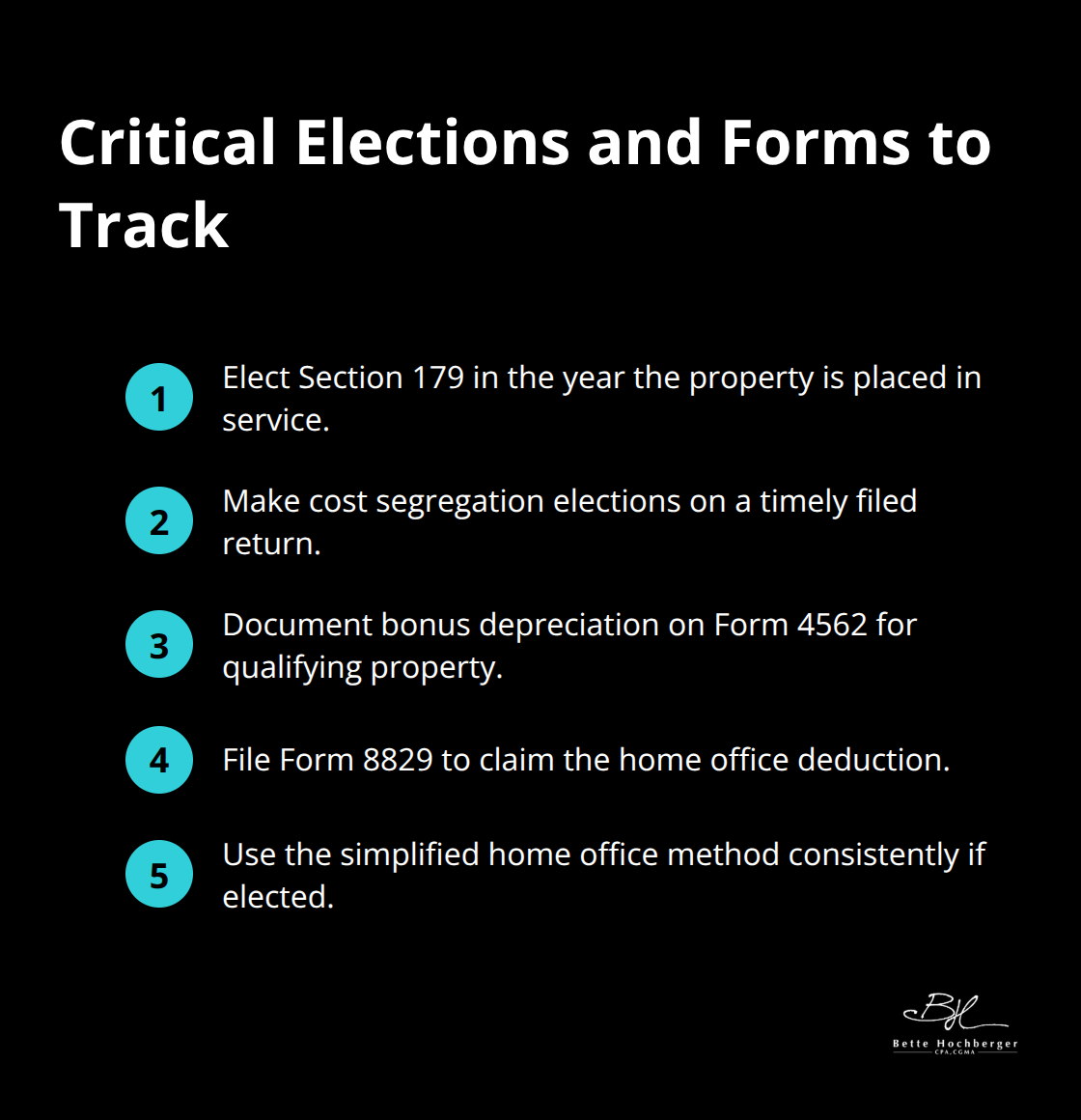
Home office deductions for self-employed owners require Form 8829 filed with your tax return, and the simplified method of $5 per square foot up to 300 square feet must be elected consistently. Many owners fail to claim these deductions simply because they do not file the required forms or make the elections in the correct tax year. The cost of this oversight compounds across multiple years since you cannot retroactively claim deductions for prior tax periods.
Documentation Gaps Invite IRS Scrutiny and Penalties
Inadequate records represent the third major mistake that undermines legitimate deductions. The IRS expects you to maintain receipts, canceled checks, bills, and travel records related to rental activity to substantiate income and expenses. Without this documentation, you cannot defend your position if the IRS questions your return. Property owners who track expenses informally (in notebooks, email threads, or memory) face disallowances that could have been prevented with organized records.
A property tax calendar established in January tracks when each strategy requires documentation or filing action, preventing the costly oversight of deadlines that cannot be recovered. This calendar should note when cost segregation studies must be completed, when Section 179 elections are due, and when bonus depreciation documentation must be filed. The investment in this organizational system pays for itself through recovered deductions and avoided penalties.
Final Thoughts
Real estate tax deductions form the backbone of wealth-building for property owners, yet most investors claim only a fraction of what they qualify for. Mortgage interest deductions, property tax deductions within the SALT cap, depreciation on rental properties, and the distinction between repairs and capital improvements represent the foundation every owner must understand. Beyond these basics, cost segregation studies, bonus depreciation, Section 179 expensing, and 1031 exchanges accelerate your tax savings significantly when structured correctly.
The mistakes that cost owners money rarely stem from aggressive tax positions. Instead, they come from misclassifying repairs as improvements, missing filing deadlines for critical elections, and failing to maintain documentation that supports your deductions. A single missed Section 179 election or incomplete cost segregation study can cost you tens of thousands in lost deductions that cannot be recovered in future years.
Your real estate tax strategy requires more than annual tax preparation-it demands advance planning that coordinates your property acquisitions, entity structure, depreciation elections, and professional service timing throughout the year. We at Bette Hochberger, CPA, CGMA specialize in strategic tax planning for real estate investors and property owners. Contact us to review your current real estate tax position and build a strategy that captures every deduction you deserve.