
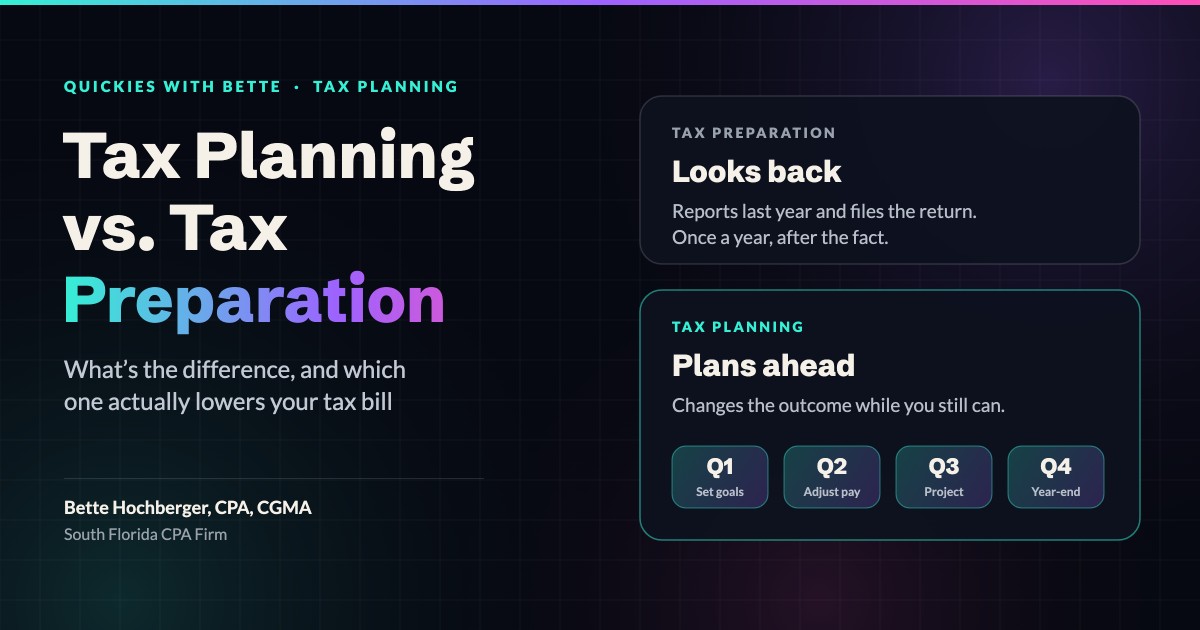
Quick answer: Tax preparation looks backward. It reports what already happened and files the return. Tax planning looks forward. It happens during the year, while you can still change the outcome, by timing income and expenses, choosing the right entity and owner pay, funding retirement accounts and setting estimated payments. Preparation keeps you compliant. Planning is what lowers the bill. Most business owners, investors and high earners need both, with planning check-ins every quarter and the return at the end.
Most people meet their CPA once a year, in March or April, with a folder of forms. By then almost every number on the return is already locked in. The return can be accurate and on time, and you can still pay thousands more than you needed to, because the decisions that move your tax happened months earlier without anyone looking at them.
That gap is the difference between tax preparation and tax planning. This guide explains both, shows what a year-round planning roadmap looks like, and helps you decide which one you actually need.
Key Takeaways
- Preparation reports the past. It turns your records into an accurate return and files it on time.
- Planning changes the future. It models decisions before the year ends, when timing, structure and contributions can still be adjusted.
- Most savings come from timing and structure. Entity choice, owner salary, retirement contributions and when income or expenses land matter more than chasing extra deductions in April.
- Quarterly is the right rhythm. Estimated tax deadlines fall in April, June, September and January, which makes them natural planning check-ins.
- Good planning needs good books. Planning only works when your accounting is current, which is why bookkeeping, planning and advisory work best when one team handles them.
What Is Tax Preparation?
Tax preparation is the compliance work of turning a year of activity into a correct tax return. A preparer collects your W-2s, 1099s, K-1s, brokerage statements and business financials, applies the tax rules, prepares the federal and any required state returns, and files them by the deadline or on extension.
Good preparation matters. It keeps you out of penalty trouble, catches the deductions and credits you already qualify for and creates a clean record if the IRS ever asks questions. But by design it works with facts that are already final. A preparer in April cannot go back and change how you paid yourself last year or when you bought that equipment.
What Is Tax Planning?
Tax planning is the year-round work of projecting your tax and making decisions while they can still change the result. Instead of asking “what do I owe,” it asks “what should I do before this year ends, and what will that do to my tax.”
Planning usually covers:
- Entity structure. Whether a sole proprietorship, an LLC or an S corporation election fits your current profit. See our guide to S corp vs LLC in Florida.
- Owner compensation. Setting a reasonable salary and distribution mix for S corporation owners.
- Timing. Deciding when to send invoices, buy equipment, sell investments or close a transaction.
- Retirement contributions. Choosing between a 401(k), SEP-IRA or other plans, and how much to fund.
- Estimated payments. Paying the right amount each quarter so there is no penalty and no surprise.
- Big events. Planning around a business sale, a property purchase, a move to Florida or a large bonus before it happens.
Tax Planning vs. Tax Preparation at a Glance
| Tax preparation | Tax planning | |
|---|---|---|
| Main question | What do I owe for last year? | What should I do now to owe less? |
| Timing | After the year ends | During the year, before deadlines |
| Looks at | Final records and forms | Projections and decisions |
| Main result | An accurate, filed return | A lower tax bill and fewer surprises |
| How often | Once a year | Quarterly check-ins plus year-end |
| Best for | Everyone who has to file | Business owners, investors and high earners |
What a Year-Round Tax Planning Roadmap Looks Like
The easiest way to make planning stick is to tie it to dates you already have. Federal estimated tax payments for the 2026 tax year are due April 15, June 15 and September 15, 2026, and January 15, 2027. Those four dates make natural checkpoints.
| Quarter | Planning focus |
|---|---|
| Q1 (January to March) | Finish last year’s return, confirm the first estimate and set this year’s goals and entity decisions. |
| Q2 (April to June) | Review year-to-date profit, adjust owner pay and the second estimate, plan any big purchases. |
| Q3 (July to September) | Run a mid-year projection, test retirement plan options and update the third estimate. |
| Q4 (October to December) | Make year-end moves: timing income and expenses, funding retirement accounts and charitable giving. |
Our team uses this rhythm with planning clients, with an estimated tax calculation and a strategy meeting built into each quarter. When year-end arrives, the work is a confirmation, not a scramble. For the final-quarter checklist, see year-end tax planning for 2026.
A Simple Example of Planning at Work
Example: A business owner’s total federal tax last year was $40,000, and their adjusted gross income was over $150,000. Under the IRS safe harbor rules, paying at least 110% of last year’s tax through withholding and estimates, or $44,000, generally avoids an underpayment penalty for this year, even if this year turns out to be a much bigger year. A planner sets four $11,000 payments on the estimate dates, then uses the mid-year projection to decide whether to pay more to avoid a large balance due in April.
Nothing about that example is exotic. It is simply a decision made on time, which is what most of the value in tax planning comes down to.
Who Needs Tax Planning, Not Just Preparation?
If any of these describe you, a once-a-year return is probably leaving money on the table:
- You own a business or practice with meaningful profit
- You are paid through an S corporation or are thinking about electing one
- Your income swings a lot from year to year
- You own rental property or invest actively
- You are planning to sell a business, property or large investment
- You recently moved to Florida from a higher-tax state
- You owed a large balance or a penalty last April
Where Business Advisory and a Fractional CFO Fit
Tax planning answers how a decision affects your tax. Business advisory and Fractional CFO work answer whether the decision makes sense for the business at all: whether you can afford the hire, what the price increase does to margins, how much cash you need for the next six months and what a lender or investor will want to see.
The three work best together. The forecast a Fractional CFO builds is the same projection a tax planner needs, and both depend on accurate monthly accounting. That is why the firm keeps bookkeeping, tax preparation, tax planning and advisory with one coordinated team instead of four separate vendors.
Common Mistakes
- Waiting until the return is prepared to ask how to lower the tax
- Choosing an entity once and never revisiting it as profit grows
- Paying estimates based on an old year instead of a current projection
- Planning from bank balances instead of up-to-date books
- Making a big purchase or sale before checking the tax impact
Frequently Asked Questions
Is tax planning worth the cost?
For most business owners, investors and high earners, yes. A single well-timed decision, such as the right entity election, a retirement contribution or estimated payments that avoid a penalty, can cover the cost of planning. If your only income is a single W-2 with no investments, basic preparation may be all you need.
When should I start tax planning?
As early in the year as possible. Many decisions, such as an S corporation election or setting owner salary, work best in the first quarter, and every month that passes leaves fewer options. Planning in December still helps, but planning in March helps more.
Can my tax preparer also do tax planning?
Sometimes. Many preparers only work during filing season, so ask directly whether they offer year-round planning, mid-year projections and quarterly check-ins. If the only time you hear from your preparer is when the return is due, you are getting preparation, not planning.
How often should a tax plan be updated?
At least quarterly, around the estimated tax deadlines, and any time something big changes: a large sale, a new business, a move to another state or a major shift in income.
What is the difference between a CPA, a tax advisor and a Fractional CFO?
A CPA is a licensed accountant who can prepare returns, plan and represent you before the IRS. A tax advisor focuses on planning and strategy. A Fractional CFO focuses on the financial management of a business, including cash flow, forecasting and reporting. At a firm like ours, one team can cover all three roles.
Get a Plan, Not Just a Return
If you want your next return to confirm a plan instead of delivering a surprise, start with a short conversation. Book a 15-minute discovery call with Bette Hochberger, CPA, CGMA, or learn more about our tax preparation and tax planning services.
This article is for general information and is not tax or legal advice for your situation. Examples are simplified. Talk with a qualified CPA before making changes based on it.
Sources: IRS: About Form 1040-ES, Estimated Tax for Individuals; IRS Topic 306: Penalty for underpayment of estimated tax; IRS: About Form 2553, Election by a Small Business Corporation.