
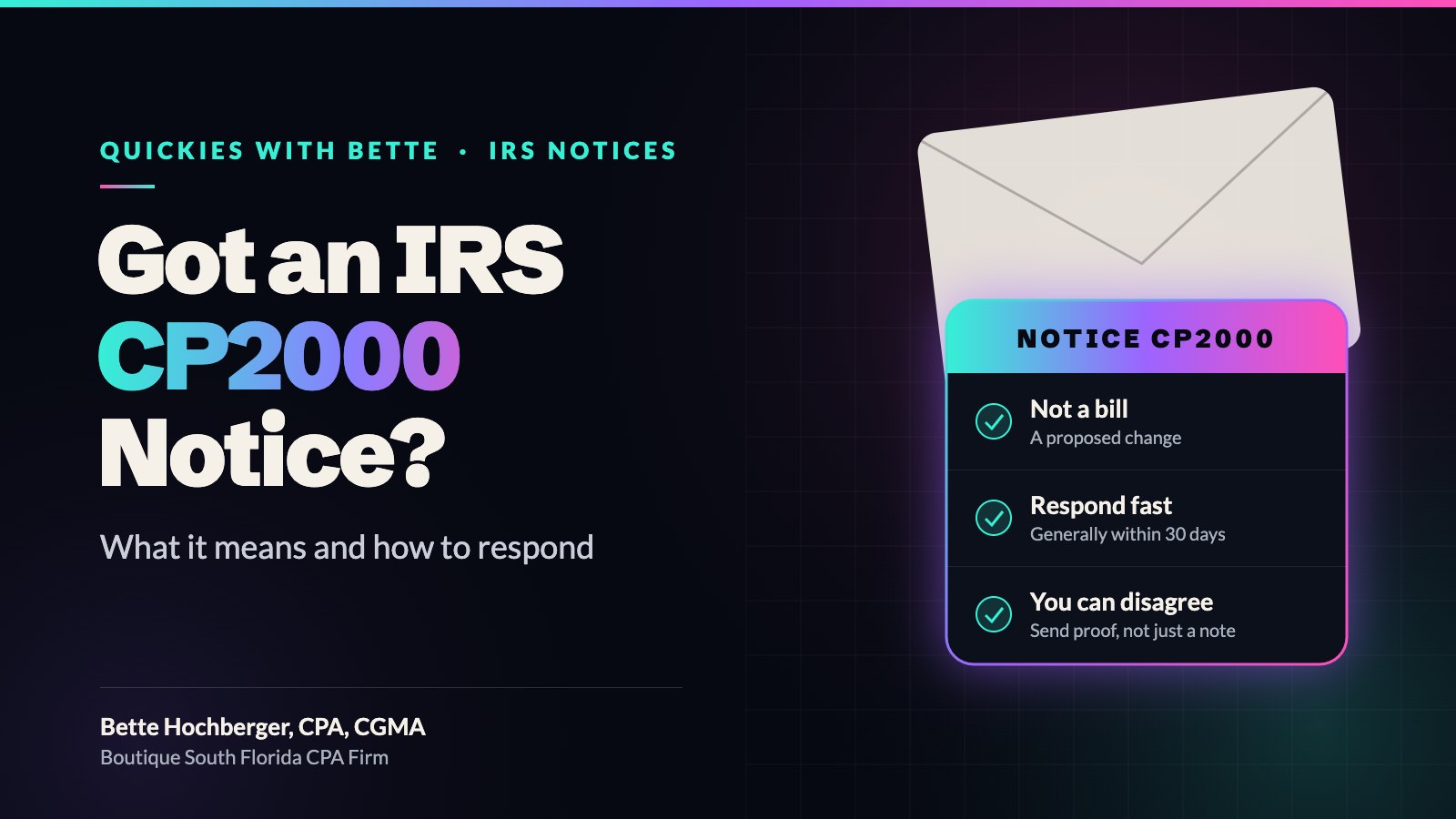
Quick answer: A CP2000 is an IRS notice saying the income or payments on your tax return don’t match what employers, banks, brokers or other third parties reported. It is not a bill and not a full audit. It is a proposal to change your return. You generally have 30 days from the notice date to respond (60 days if you live outside the U.S.) by agreeing, partially agreeing or disagreeing with supporting documents. If you ignore it, the IRS can send a Statutory Notice of Deficiency and then assess the tax, interest and penalties.
Few things ruin a week faster than an envelope from the IRS. If yours says “CP2000” in the top right corner, take a breath. A CP2000 is one of the most common IRS notices, and many of them can be resolved by mail with the right documents. Many are partly or fully wrong, usually because the IRS is missing cost basis, sees the same income twice or doesn’t know about a deduction or exclusion you are entitled to.
This guide explains what a CP2000 notice means, why you received it, exactly how to respond, the deadlines that matter and when it makes sense to have a CPA handle it for you.
Key Takeaways
- A CP2000 is a proposal, not a bill. The IRS is proposing changes based on a computer match of your return against third-party forms.
- The deadline is short. Respond by the date on the notice, generally 30 days from the notice date (60 days if you live outside the U.S.). You can ask for more time.
- You can disagree. Many CP2000s overstate what you owe, especially for stock, crypto and real estate sales reported without cost basis.
- Do not file an amended return just to answer it. Use the response form. Only file Form 1040-X if the notice is correct and you also have other changes to report.
- Ignoring it gets expensive. No response leads to a Statutory Notice of Deficiency, then an assessed balance with interest and possible penalties.
What Is an IRS CP2000 Notice?
The IRS Automated Underreporter (AUR) program compares the income you reported with information returns filed by third parties, such as Forms W-2, 1099-NEC, 1099-K, 1099-B, 1099-DIV, 1099-INT, 1099-R and 1099-DA. When the numbers don’t match, a tax examiner reviews the difference and may send a CP2000 that lists the information the IRS received, the changes it proposes and the resulting tax, interest and any penalty.
Because it is handled by correspondence, a CP2000 is not the same as an in-person or field audit. But it is a formal proposal, and if it is not answered, the IRS can move forward and assess the amount.
Why Did I Get a CP2000? Common Causes
- Stock or crypto sales with missing cost basis. A Form 1099-B or 1099-DA shows gross proceeds, and if the IRS doesn’t see your basis, it may treat the entire sale amount as profit. This is one of the most common reasons a CP2000 overstates tax.
- Missing 1099 income. A 1099-NEC or 1099-MISC from a client that never made it onto your return.
- Form 1099-K payment app or card income. Payments through card processors and online platforms that look like unreported income even when they were already included in your business revenue.
- Retirement distributions and rollovers. A 1099-R for a rollover that was reported as a taxable distribution, or a distribution that was missed.
- Interest and dividends. Small 1099-INT or 1099-DIV forms from accounts you forgot about.
- Income reported under the wrong entity. Business income reported to your Social Security number when it belongs on an S corp or partnership return, or vice versa.
- Duplicate reporting. The same income shown on two forms, such as a 1099-K and a 1099-NEC for the same payment.
How to Respond to a CP2000 Notice: Step by Step
Step 1: Read the whole notice and note the response date
Find the response date and the tax year. Read every page, including the list of information returns the IRS received and how it calculated the proposed change.
Step 2: Compare each item to your return and records
Go line by line. Was the income already reported somewhere else on your return, such as on Schedule C or under a business entity? Is cost basis missing? Is a 1099 wrong or duplicated? Gather brokerage statements, closing statements, bank records, corrected 1099s and anything else that supports your position.
Step 3: Decide whether you agree, partially agree or disagree
If the IRS is right, you can agree, sign the response form and pay or set up a payment plan. If it is partly or fully wrong, check the box that applies, write a clear signed statement explaining why and attach documents that prove each point.
Step 4: Send your response the right way
Return the signed response form and documents by the IRS Documentation Upload Tool, fax or mail, using the information on your notice. If you filed jointly, both spouses sign. Keep copies of everything and proof of the date you sent it.
Step 5: Ask for more time if you need it
If you need more time to gather records, send an extension request using one of the reply options on the notice before the response date. Do not simply let the deadline pass.
Step 6: Handle payment if you owe
If you agree with some or all of the amount, you can pay online, wait for the bill or request a payment plan. Paying the agreed amount within 30 days of the notice stops additional interest, and possibly penalties, from building. Even if you pay, you still need to return the signed response form.
Step 7: Watch for the IRS reply
The IRS may accept your response, send a revised proposal or request more information. Respond to every follow-up letter by its deadline.
CP2000 Deadlines and What Happens Next
| Stage | What it means | Typical timing |
|---|---|---|
| CP2000 notice | Proposed changes to your return | Respond within 30 days of the notice date (60 days outside the U.S.) |
| Extension request | More time to gather documents | Request before the response date |
| IRS review of your response | IRS accepts, revises or asks for more | Varies, often several weeks to months |
| Statutory Notice of Deficiency | Formal notice if the matter is not resolved | 90 days to petition the U.S. Tax Court (150 days if addressed outside the U.S.) |
| Assessment and bill | Tax, interest and any penalty are assessed | After the deficiency period ends without a petition |
Penalties and Interest on a CP2000
Interest generally runs from the original due date of the return until the balance is paid. A CP2000 may also include an accuracy-related penalty, commonly 20% of the underpayment when there is a substantial understatement of income tax (generally more than the greater of 10% of the correct tax or $5,000). If you had reasonable cause, or if the proposed tax is reduced after your response, the penalty may be reduced or removed. Raise penalty relief in your response or in a follow-up request.
Common CP2000 Mistakes to Avoid
- Ignoring the notice or missing the response date.
- Agreeing just to make it go away when the IRS overstated the income, especially on investment sales.
- Filing an amended return instead of using the response form.
- Sending a statement with no documents, or documents with no explanation.
- Calling without a plan and agreeing to numbers on the phone before reviewing records.
- Forgetting to fix the cause, so the same mismatch shows up again next year.
When to Get a CPA Involved
You can respond to a simple CP2000 on your own. It is worth getting help when the proposed amount is large, when it involves stock, crypto, real estate or business income, when more than one tax year may be affected, or when you are not sure the IRS is right. A CPA can rebuild missing cost basis, match each form to your return, write the response and talk to the IRS for you with a power of attorney. In many cases the corrected amount is far lower than the original proposal.
Frequently Asked Questions
Is a CP2000 an audit?
Not in the traditional sense. It is an automated mismatch notice reviewed by an IRS examiner and handled by mail. It proposes changes to your return, and you have the right to respond before anything is assessed.
How long do I have to respond to a CP2000?
Generally 30 days from the date on the notice, or 60 days if you live outside the United States. Use the response date printed on your notice. You can request more time before that date.
What happens if I ignore a CP2000?
The IRS can issue a Statutory Notice of Deficiency. If you do not resolve it or petition the Tax Court within 90 days, the IRS assesses the tax, interest and any penalties and sends a bill.
Should I file an amended return for a CP2000?
Usually no. Respond using the CP2000 response form. File Form 1040-X only if the notice is correct and you also have other income, credits or deductions to report for that year.
Can the IRS be wrong on a CP2000?
Yes. Common errors include treating gross sale proceeds as profit because cost basis was not reported, counting the same income twice or not seeing income that was reported on a different form or entity.
Can I set up a payment plan for a CP2000?
Yes. If you agree with all or part of the amount, you can pay online or request an installment agreement. You still need to return the signed response form by the due date.
Get Help With Your CP2000 Notice
If you received a CP2000 and want it handled correctly the first time, our team can review the notice, rebuild the numbers and prepare your response. Learn more about our IRS CP2000 notice help and broader IRS representation services, or read our guide to building a strong IRS defense strategy. If crypto sales triggered the notice, see how cryptocurrency losses affect your taxes. When the response date is close, contact Bette Hochberger, CPA, CGMA right away.
This article is for general information and is not tax or legal advice for your situation. Deadlines and options depend on your notice and facts. Talk with a qualified professional before responding.
Sources: IRS Topic 652: Notice of underreported income (CP2000); IRS: Understanding your CP2000 series notice; IRS: CP2000 notices explained.