
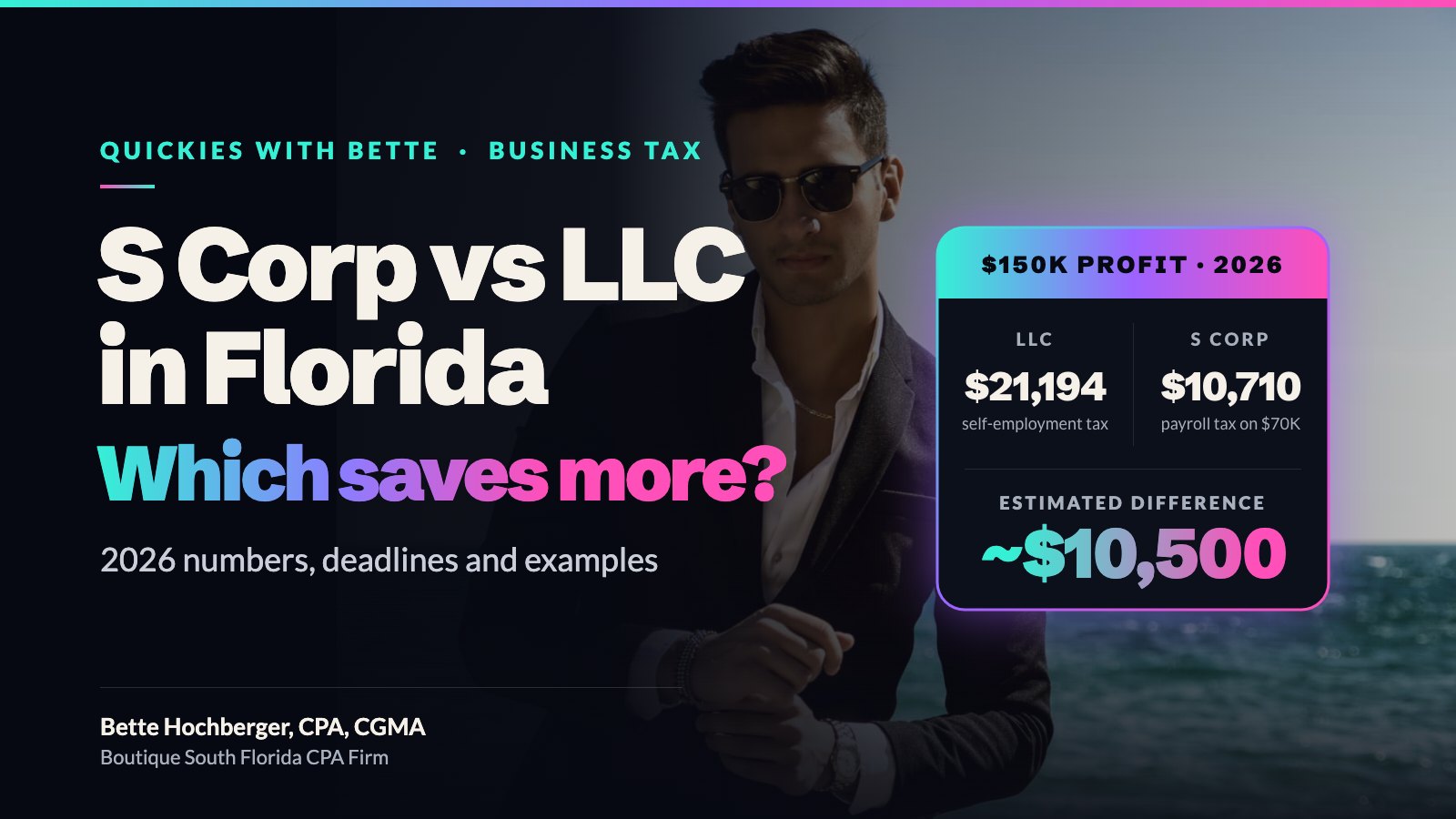
Quick answer: An LLC is a legal structure, and an S corporation is a tax election, so the real question is whether your Florida LLC should elect to be taxed as an S corp. For most profitable small businesses, an S corp election can lower self-employment taxes because you pay payroll tax only on a reasonable salary, not on all of your profit. In 2026, a Florida owner with $100,000 of profit could save roughly $6,500 in payroll taxes before costs, and about $10,500 at $150,000. The trade-off is running payroll, filing a separate business return and paying yourself a defensible salary. If your profit is low or uneven, a standard LLC is often simpler and just as good.
“Should I be an S corp?” is one of the most common questions we hear from Florida business owners, consultants, real estate professionals and medical providers. It is also one of the most misunderstood. Many owners form an LLC, hear that S corps “save taxes,” and either make the election too early or wait years too long.
This guide explains the difference between an LLC and an S corporation in Florida, shows the 2026 numbers, walks through when the election usually makes sense and covers the deadlines and mistakes to avoid.
Key Takeaways
- An LLC is how your business is organized. An S corp is how it is taxed. A Florida LLC can stay a default LLC or elect S corp taxation with IRS Form 2553.
- The main savings is self-employment tax. Default LLC owners generally pay 15.3% on most net earnings (up to the Social Security wage base of $184,500 in 2026, plus 2.9% Medicare above it). S corp owners pay payroll tax only on their salary.
- You must pay yourself a reasonable salary. Setting it too low is the biggest audit risk with S corps.
- Florida has no personal income tax, and most S corps do not pay Florida corporate income tax, so the decision is mostly about federal taxes.
- Timing matters. For an existing calendar-year business, the election for 2027 is generally due by March 15, 2027.
LLC vs S Corp: What Is the Difference?
A limited liability company (LLC) is a legal entity you form with the Florida Division of Corporations (Sunbiz). It separates your business from your personal assets and keeps paperwork light. By default, the IRS taxes a single-member LLC as a sole proprietorship (Schedule C) and a multi-member LLC as a partnership.
An S corporation is a federal tax status. A corporation or an LLC can elect it by filing Form 2553 with the IRS. The business still exists as your Florida LLC or corporation, but for tax purposes the owners become shareholder-employees who receive a salary through payroll, and remaining profit passes through to their personal returns as distributions.
| Default LLC | LLC taxed as S corp | |
|---|---|---|
| How profit is taxed | Passes to your personal return | Passes to your personal return |
| Self-employment / payroll tax | On nearly all net earnings | Only on your W-2 salary |
| Owner pay | Draws, no payroll required | Reasonable salary through payroll, plus distributions |
| Federal business return | Schedule C (single owner) or Form 1065 | Form 1120-S plus K-1s |
| Ownership rules | Flexible, any owners | Up to 100 shareholders, generally U.S. individuals, one class of stock |
| Admin and cost | Lower | Higher (payroll, separate return, bookkeeping) |
| Florida annual report | $138.75 for an LLC, due by May 1 | Same LLC fee if you keep the LLC |
How Much Can an S Corp Save in 2026?
The savings come from the difference between self-employment tax on all of your profit and payroll tax on only your salary. Here is a simplified comparison for a single Florida owner using 2026 rates. Salaries are example figures; your reasonable salary depends on your role, industry and market pay.
| Net profit | Example salary | Default LLC self-employment tax | S corp payroll tax on salary | Estimated difference |
|---|---|---|---|---|
| $60,000 | $35,000 | $8,478 | $5,355 | about $3,100 |
| $100,000 | $50,000 | $14,130 | $7,650 | about $6,500 |
| $150,000 | $70,000 | $21,194 | $10,710 | about $10,500 |
| $250,000 | $100,000 | $29,573 | $15,300 | about $14,300 |
Self-employment tax is calculated on 92.35% of net profit at 12.4% (up to the $184,500 Social Security wage base) plus 2.9% Medicare. S corp payroll tax is the combined 15.3% employer and employee share on salary. These figures exclude income tax effects, the deductible half of self-employment tax, the additional 0.9% Medicare tax, the qualified business income (QBI) deduction, payroll costs and state unemployment tax, so treat them as a starting point, not a final answer.
From those savings, subtract what the S corp costs to run: payroll processing, a separate 1120-S return, cleaner bookkeeping and sometimes state unemployment tax. That is why the election tends to pay off once profit is steady and meaningfully above the salary you would need to pay yourself.
When an S Corp Election Usually Makes Sense
- Your profit is consistent. The business reliably earns well beyond a reasonable salary for your role.
- You are actively working in the business. Consultants, agency owners, contractors, physicians and other professionals who earn through their own services often see the clearest benefit.
- Your books are in good shape. S corps require clean accounting, separate bank accounts and timely payroll.
- You are ready to run payroll. Owner salary must go through payroll with withholding, deposits and quarterly filings.
When to Stay a Default LLC
- Profit is low or unpredictable. If a reasonable salary would take most of your profit, there is little left to save.
- You hold rental real estate. Rental income generally is not subject to self-employment tax anyway, and putting appreciating property inside an S corp can create problems when you want to move or refinance it. Real estate investors usually use LLCs taxed as partnerships or disregarded entities instead.
- You have owners who do not qualify. Nonresident alien owners, other corporations and most partnerships cannot be S corp shareholders.
- You need flexible profit splits. S corps must distribute profit in proportion to ownership. Partnerships can allocate more flexibly.
- You are raising venture capital. Investors typically want a C corporation, and preferred stock is not allowed in an S corp.
What Is a “Reasonable Salary” for an S Corp Owner?
The IRS expects S corp shareholder-employees to pay themselves reasonable compensation for the work they do before taking distributions. There is no single formula. Factors include your duties, time spent, experience, what the business could pay someone else to do your job and industry pay data. Paying yourself $0 or an unrealistically low salary to avoid payroll tax is a well-known audit target, and the IRS can reclassify distributions as wages and assess back taxes and penalties.
A defensible salary is usually documented with market pay data and reviewed each year as the business grows.
How to Elect S Corp Status for a Florida LLC
Step 1: Confirm you qualify
Check your owners and structure. S corps can have up to 100 shareholders, generally U.S. citizens or residents, certain trusts and estates, and only one class of stock.
Step 2: Run the numbers
Project your profit, set a reasonable salary and compare total taxes and costs under both options. Include the QBI deduction, retirement contribution plans and any state unemployment tax.
Step 3: File IRS Form 2553
For an existing calendar-year business, file by March 15 of the year you want the election to start (no more than 2 months and 15 days after the start of the tax year). A new business has 2 months and 15 days from the start of its first tax year. Every shareholder signs the form. If you missed the deadline, the IRS offers late election relief in many cases when there was reasonable cause.
Step 4: Set up payroll
Register for payroll, set up withholding and deposits, and register with the Florida Department of Revenue for reemployment (unemployment) tax if required. Start paying your salary on a regular schedule.
Step 5: Keep the business separate and current
Use a separate business bank account, keep monthly books, reimburse expenses through an accountable plan, file Form 1120-S by March 15 each year and file your Florida annual report on Sunbiz between January 1 and May 1 to avoid the $400 late fee.
Common S Corp Mistakes We See
- Electing S corp status in the first year before the business is consistently profitable.
- Paying no salary, or a salary far below market for the work performed.
- Taking distributions that are not proportional to ownership.
- Mixing personal and business expenses in the same account.
- Forgetting the 1120-S deadline, which can trigger per-shareholder, per-month penalties.
- Putting rental real estate inside the S corp without considering the long-term consequences.
Frequently Asked Questions
Is an S corp better than an LLC in Florida?
Neither is better in every case. An S corp election usually saves payroll taxes once your business is consistently profitable above a reasonable salary. A default LLC is simpler and often better when profit is low, uneven or comes from rental real estate.
At what income does an S corp make sense?
There is no fixed number, but the savings grow as profit rises above the salary you would need to pay yourself. In the 2026 examples above, the payroll tax difference is about $3,100 at $60,000 of profit and about $10,500 at $150,000, before the added costs of payroll and a separate return.
Can a single-member LLC be taxed as an S corp?
Yes. A single-member Florida LLC can elect S corp taxation by filing Form 2553. The LLC stays in place under Florida law, and only the federal tax treatment changes.
Does Florida tax S corporations?
Florida does not have a personal income tax, and most S corporations do not pay Florida corporate income tax because profit passes through to the owners. There can be exceptions when an S corp owes federal tax at the entity level, so confirm your filing requirements each year.
When is the deadline to elect S corp status for 2027?
For an existing calendar-year business, Form 2553 is generally due by March 15, 2027 for the election to apply to the 2027 tax year. New businesses have 2 months and 15 days from the start of their first tax year.
Do I need a CPA to become an S corp?
You can file Form 2553 yourself, but most of the value is in the planning: choosing the timing, setting a defensible salary, setting up payroll correctly and making sure the books support the return. Mistakes in those areas usually cost more than the savings.
Get a Clear Answer for Your Business
The right structure depends on your profit, your goals and how you work, and it is worth revisiting as the business grows. Our team helps Florida business owners model the numbers, set reasonable compensation, set up payroll and keep the books and tax returns aligned. If you are deciding before year-end or before the March 15 deadline, our tax planning sessions are a good place to start. Contact Bette Hochberger, CPA, CGMA to talk through your situation.
This article is for general information and is not tax or legal advice for your situation. Examples are simplified and rounded. Talk with a qualified CPA before changing your entity or tax election.
Sources: IRS: S corporations; IRS: About Form 2553; IRS: Self-employment tax; Journal of Accountancy: 2026 Social Security wage base; Florida Trend: Florida annual report fees.