
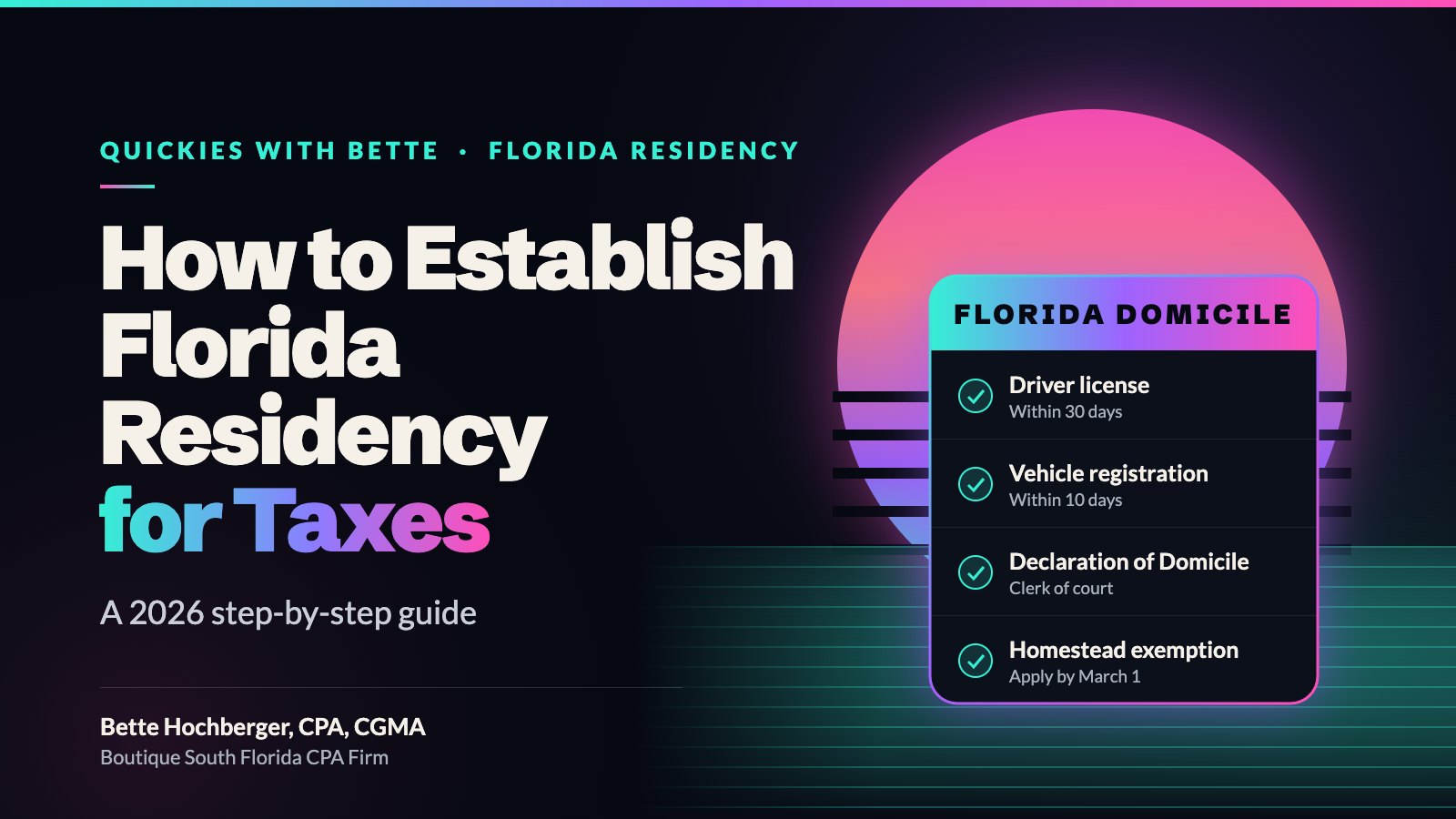
Quick answer: To establish Florida residency for tax purposes, you need to make Florida your true, permanent home (your “domicile”) and be able to prove it. In practice that means living in a Florida home you intend to keep, getting a Florida driver license within 30 days, registering your vehicles within 10 days, registering to vote, filing a Declaration of Domicile, claiming the homestead exemption by March 1 if you own your home, and cutting real ties to your former state. Your old state, not Florida, decides whether you have truly left, so documentation matters as much as the move itself.
Florida has no state personal income tax, which is why so many business owners, executives, investors and retirees move here from New York, New Jersey, California, Illinois and Massachusetts. But buying a condo in Miami does not automatically make you a Florida resident for tax purposes. High-tax states audit people who leave, and they look at how you actually live, not just what your paperwork says.
This guide explains what Florida domicile means, the exact steps and deadlines to establish it, how states like New York test residency, and the most common mistakes that lead to an audit.
Key Takeaways
- Domicile is about intent plus proof. You can have several homes but only one domicile, the place you intend to return to and treat as your permanent home.
- Florida has fast deadlines: a driver license within 30 days and vehicle registration within 10 days of establishing residency.
- The homestead exemption requires residency on January 1 and an application by March 1 with your county property appraiser.
- Your former state can still tax you if you keep a home there and spend too many days there, even after you move.
- Timing matters in 2026. A proposed Florida homestead amendment on the November 3, 2026 ballot would treat people who move after December 31, 2026 differently if it is approved.
What Does “Florida Residency for Tax Purposes” Mean?
For state income tax, two ideas matter: domicile and statutory residency.
Domicile is your permanent legal home. It is where you live, where your life is centered and where you intend to return after time away. You can only have one domicile at a time. Changing it requires two things: physically moving and genuinely intending to make the new place your permanent home.
Statutory residency is a separate test some states use to tax people who are not domiciled there. New York is the best-known example. Even if your domicile is in Florida, New York can treat you as a resident for the year if you keep a permanent place of abode in New York and spend more than 183 days there.
Florida itself does not impose a minimum number of days to become a resident. The challenge is almost always proving to your former state that you left.
How to Establish Florida Residency: Step by Step
Step 1: Establish a Florida home you actually live in
Buy or lease a Florida home and move into it. A home you live in year-round, with your family and belongings, is stronger evidence than a seasonal condo. If you keep your old home, be ready to show why Florida, not the old house, is now the center of your life.
Step 2: Get a Florida driver license within 30 days
The Florida Department of Highway Safety and Motor Vehicles requires new residents to get a Florida driver license within 30 days of establishing residency. Surrender your old state’s license when you do.
Step 3: Title and register your vehicles within 10 days
New residents must title and register vehicles, vessels and mobile homes within 10 days of establishing residency, and you need Florida auto insurance first. Cars still registered in your old state are one of the first things an auditor notices.
Step 4: Register to vote in Florida
Register with your county supervisor of elections (you can do it when you get your license), then cancel your registration in your former state. Voting in your old state after you move undercuts your claim.
Step 5: File a Declaration of Domicile
Under Florida Statutes section 222.17, you can file a sworn Declaration of Domicile with the clerk of the circuit court in your county. It is voluntary and inexpensive, but it creates a dated, public record of your intent to make Florida your permanent home.
Step 6: Apply for the homestead exemption
If you own your Florida home and it is your permanent residence as of January 1, you can apply for the homestead exemption with your county property appraiser by March 1. The exemption removes up to $50,000 of assessed value ($25,000 applies to all property taxes, and an additional $25,000 applies to assessed value between $50,000 and $75,000, excluding school taxes). It also triggers the “Save Our Homes” cap, which limits annual increases in assessed value to 3% or the change in CPI, whichever is lower. If you are moving from one Florida homestead to another, portability can transfer up to $500,000 of that accumulated benefit.
Step 7: Move your financial, professional and legal life
Update your address with the IRS, Social Security, banks, brokerage accounts, credit cards and insurance. Move safe deposit boxes. Update your will, trusts and powers of attorney with a Florida attorney. Find Florida doctors, a Florida CPA and Florida-based advisors. Join local clubs, houses of worship and charities.
Step 8: Cut ties to your former state
Cancel your old homestead or principal residence exemption, voter registration and vehicle registrations. File a final part-year resident return in your former state for the year you move. If you keep a home there, consider how it is used, who lives there and how many days you spend there.
Florida Residency Checklist and Deadlines
| Action | Deadline or timing | Where |
|---|---|---|
| Florida driver license | Within 30 days of establishing residency | FLHSMV / county tax collector |
| Vehicle title and registration | Within 10 days of establishing residency | County tax collector |
| Voter registration | As soon as practical after moving | County supervisor of elections |
| Declaration of Domicile | Voluntary, file soon after moving | Clerk of the circuit court |
| Homestead exemption | Live there January 1, apply by March 1 | County property appraiser |
| Final return in former state | That state’s filing deadline for the move year | Former state tax agency |
| Update IRS address | When you move (Form 8822) | IRS |
How Your Former State Tests Whether You Really Left
States with high income taxes often audit taxpayers who move to Florida, especially in the first few years. New York is the most aggressive, and its approach is a useful model for what other states look at.
The domicile test
New York auditors look at objective factors, including your home (size, value and use of each residence), time (where you actually spend your days), business ties (whether you still actively run a business there), family ties (where your spouse and minor children live) and near and dear items (where you keep the things that matter most to you, like family heirlooms, art or pets). The burden is on you to prove the change by clear and convincing evidence.
The statutory residency test
Even if you are domiciled in Florida, New York can tax you as a resident if you maintain a permanent place of abode in New York for substantially all of the year and spend more than 183 days in the state. Part of any day spent in New York generally counts as a day there, so a quick trip for a dinner or meeting adds up.
What auditors request
Expect requests for calendars, phone records, credit card statements, E-ZPass and travel records, utility bills for each home, and proof of where you see doctors, work and socialize. Many states also cross-check Florida driver license and homestead records.
Common Mistakes That Trigger Residency Audits
- Keeping a larger, more valuable home in your former state and treating Florida as the “vacation” house.
- Spending more days in your former state than in Florida, or not tracking days at all.
- Leaving your spouse, children or pets in the former state.
- Continuing to actively run a business from your old office.
- Keeping your old doctors, country club, voter registration or car registrations.
- Selling a business or large asset right after “moving,” which invites a closer look at timing.
- Filing paperwork in Florida but changing nothing about how you actually live.
Timing Your Move: Why 2026 Matters
Florida voters will decide a proposed constitutional amendment on November 3, 2026 that would expand the homestead exemption for non-school property taxes, rising to $150,000 in 2027 and $250,000 in 2028. As proposed, people who move to Florida after December 31, 2026 would receive a smaller initial exemption and would need five years of residency to qualify for the full amount. The amendment needs 60% of the vote to pass. If you are planning a move, it is worth watching the result and talking with your advisors about timing.
Income timing matters too. If you expect a large gain, such as a business sale, stock vesting or real estate sale, the date your Florida domicile is established can affect which state has the right to tax it. Planning that before the transaction is far easier than defending it afterward.
How a Florida CPA Helps With a Residency Change
Moving to Florida is a legal and tax project, not just a change of address. A CPA can help you plan the timing around income events, file part-year resident returns correctly, organize day counts and documentation, and respond if your former state opens an audit. Our Florida residency services are built for people relocating from high-tax states, and our tax planning and strategy work helps time income and gains around the move. If you own investment property, our real estate CPA services can help with the property side.
Frequently Asked Questions
How long do I have to live in Florida to become a resident?
Florida has no minimum waiting period. You can become a Florida resident as soon as you live in a Florida home with the intent to make it your permanent home. Your former state, however, may still tax you for that year if you also meet its residency tests.
Does Florida have a state income tax?
No. Florida does not tax personal income, including wages, retirement income and capital gains. Florida residents still pay federal income tax, and Florida has property taxes and sales tax.
Is a Declaration of Domicile required in Florida?
No, it is voluntary. It is a sworn statement filed with the clerk of the circuit court under Florida Statutes section 222.17. It does not establish domicile on its own, but it is helpful evidence of your intent.
What is the 183-day rule?
Some states, including New York, treat you as a statutory resident if you keep a permanent place of abode there and spend more than 183 days in the state during the year. Florida does not use this rule to grant residency. The rule matters because your former state can use it to tax you even after you move.
Can I keep my home in New York or New Jersey and still be a Florida resident?
Yes, but it raises the bar. Keeping a former home makes day counts, how you use each home and where your life is centered much more important. Many people who keep a home up north carefully limit and document their days there.
When is the Florida homestead exemption deadline?
You must own and live in the home as your permanent residence on January 1, and apply with your county property appraiser by March 1 of that year.
Will my old state audit me after I move to Florida?
It is possible, especially if you had high income, kept a home there or sold a business or asset around the time you moved. Strong documentation from the start is the best protection.
Make the Move With a Plan
Becoming a Florida resident can lower your state tax bill for years, but only if the move holds up. Start with the steps above, document as you go, and plan income events around your timing. If you are relocating to South Florida or thinking about it, contact Bette Hochberger, CPA, CGMA to talk through your plan.
This article is for general information and is not tax or legal advice for your situation. Residency rules vary by state and depend on your facts. Talk with a qualified CPA and attorney before acting.
Sources: Florida Highway Safety and Motor Vehicles: New Residents; Florida Statutes section 222.17; Property appraiser homestead exemption guidance; Miami-Dade Property Appraiser: Portability; CBIZ: New York statutory residency; Ballotpedia: 2026 Florida homestead amendment.