

December has a way of sneaking up on business owners. One week you are closing a strong quarter, and the next you are wondering why nobody mentioned that a December equipment purchase or an extra retirement contribution could have changed your tax bill. Year-end tax planning in 2026 matters more than usual, because this is the first full year that many of the changes from the One, Big, Beautiful Bill Act (signed July 4, 2025) apply to your return.
Below are 12 practical moves to review with your CPA before December 31, 2026, along with the key numbers for this year. Not every move fits every situation. The right ones depend on your income, your entity, your cash flow and what you are planning for 2027.
Why Year-End Tax Planning Looks Different in 2026
The 2025 tax law made several provisions permanent and added new ones. A few that shape this year’s planning:
- 100% bonus depreciation is back and permanent for qualified property acquired and placed in service after January 19, 2025.
- The qualified business income (QBI) deduction is permanent at up to 20%, with wider phase-in ranges starting in 2026.
- The state and local tax (SALT) cap is $40,400 for 2026, up from the old $10,000 limit, with a phase-down for higher incomes.
- New charitable rules start in 2026, including a deduction for people who do not itemize and a new 0.5% of AGI floor for people who do.
Because several of these rules changed at once, last year’s plan may not fit this year. That is the case for a fresh review.
2026 Tax Numbers to Know
| Item | 2026 amount |
|---|---|
| Standard deduction (single / married filing jointly) | $16,100 / $32,200 |
| Standard deduction (head of household) | $24,150 |
| 401(k) employee deferral | $24,500 |
| 401(k) catch-up (age 50+) / age 60 to 63 | $8,000 / $11,250 |
| IRA contribution (plus catch-up at 50+) | $7,500 (+$1,100) |
| HSA (self-only / family) | $4,400 / $8,750 |
| Section 179 expensing limit | $2,560,000 (reduced once purchases pass $4,090,000) |
| SALT deduction cap | $40,400 (phase-down above $505,000 MAGI) |
| Annual gift tax exclusion | $19,000 per recipient |
| Estate and lifetime gift exclusion | $15,000,000 per person |
Figures come from IRS inflation adjustments and IRS guidance for tax year 2026. Your own limits can differ based on income, plan type and filing status.
12 Year-End Tax Moves for Business Owners and Investors
1. Time equipment and vehicle purchases
With 100% bonus depreciation and a Section 179 limit of $2,560,000 for 2026, qualifying equipment, software and certain vehicles bought and placed in service by December 31 can often be deducted this year. “Placed in service” is the key phrase. Equipment sitting in a box in January does not count for 2026. Buy for business reasons first, then use the timing to your advantage.
2. Review your entity and owner pay
If you run an S corporation, year-end is the time to confirm your salary is reasonable and that payroll reflects it before the final run of the year. If you are still a sole proprietor or single-member LLC with meaningful profit, it is worth modeling whether an S corporation election makes sense for 2027. Entity choice affects self-employment tax, the QBI deduction and how investors and buyers see your company later.
3. Make the most of the QBI deduction
The QBI deduction lets many owners of pass-through businesses deduct up to 20% of qualified business income. For 2026, the income range where limits phase in is wider ($150,000 for joint filers and $75,000 for others), and there is a new minimum deduction of $400 for taxpayers with at least $1,000 of QBI from an active business. If your income is near the thresholds, moves like retirement contributions or timing income can change how much of the deduction you keep.
4. Max out retirement contributions
Employee 401(k) deferrals generally need to come out of paychecks by December 31, so check your year-to-date total now. For 2026 the limit is $24,500, with an $8,000 catch-up at age 50 and a larger $11,250 catch-up for ages 60 to 63. One change to know: if your 2025 Social Security wages were over $150,000, your 2026 catch-up contributions generally must go in as Roth.
Business owners have more room. A SEP IRA or solo 401(k) can allow much larger contributions (total annual additions up to $72,000 for 2026, before catch-ups), and some plans can still be funded after year-end. If you want a solo 401(k) for 2026, talk with your CPA soon, because setup deadlines matter.
5. Fund your HSA
If you have a qualifying high-deductible health plan, health savings account contributions are deductible going in, grow tax-free and come out tax-free for qualified medical costs. For 2026 the limits are $4,400 for self-only coverage and $8,750 for family coverage, plus a $1,000 catch-up at age 55. Contributions for 2026 can generally be made until the April 2027 filing deadline.
6. Defer income or accelerate expenses (when it makes sense)
Cash-basis businesses can sometimes delay invoicing until late December so payment lands in January, or prepay certain deductible expenses before year-end. This works best when you expect to be in the same or a lower bracket next year. If 2027 looks like a bigger year, accelerating income into 2026 may actually save more. Run the numbers both ways.
7. Harvest investment losses
Selling investments that are down can offset capital gains, plus up to $3,000 of ordinary income, with the rest carried forward. Watch the wash sale rule for stocks and funds: buying a substantially identical investment within 30 days before or after the sale disallows the loss. Crypto has its own reporting details, so see our guide on how cryptocurrency losses reduce your overall tax burden.
8. Re-think charitable giving under the new rules
Starting in 2026, people who take the standard deduction can deduct up to $1,000 ($2,000 married filing jointly) of cash gifts to qualifying public charities. Itemizers now face a floor: only charitable gifts above 0.5% of AGI count, and the benefit is capped at 35% for those in the top bracket.
That makes strategy matter. “Bunching” several years of gifts into one year, giving appreciated stock instead of cash, or using a donor advised fund can all help. If you are 70½ or older, a qualified charitable distribution from your IRA can satisfy giving goals without adding to AGI. For more ideas, read strategic charitable deductions that benefit your business and community.
9. Check whether the higher SALT cap changes your plan
The SALT cap of $40,400 for 2026 means more people may benefit from itemizing again. In Florida, there is no state income tax, so for most residents SALT comes down to property taxes plus either state income tax from another state or general sales tax. If you own significant real estate, paying a property tax bill before December 31 may help, as long as it was assessed and you will itemize. The cap phases down by 30% of modified AGI above $505,000, with a floor of $10,000, so high earners should check before counting on it.
10. Real estate owners: look at cost segregation and depreciation
If you bought, built or renovated property, a cost segregation study can reclassify parts of the building into shorter-lived categories. Combined with 100% bonus depreciation, that can create large first-year deductions. Short-term rental owners and real estate professionals should also confirm their hours and participation records now, since those rules decide whether losses can offset other income. Learn more about cost segregation studies and our real estate CPA services.
11. Use gifting and estate tools while they are available
You can give up to $19,000 per person in 2026 without using any of your lifetime exemption, and a married couple can give $38,000 per recipient. The estate and lifetime gift exclusion is $15,000,000 per person for 2026. Annual exclusion gifts do not carry over, so if family gifting is part of your plan, December 31 is the deadline for this year’s.
12. Get your estimated payments and records in order
The fourth quarter 2026 estimated tax payment is generally due January 15, 2027. If income jumped this year, paying enough to meet the safe harbor can help you avoid underpayment penalties. Year-end is also a good time to reconcile your books, collect W-9s from contractors for January 1099 filing, and make sure business and personal expenses are separated. Clean records make every other move on this list easier. Consultants and freelancers may find our guide to handling quarterly estimated taxes useful.
Your Year-End Tax Planning Checklist
- Pull year-to-date profit and loss numbers and project the full year.
- List planned equipment, vehicle or software purchases and when they will be placed in service.
- Confirm 401(k), HSA and other retirement contributions year to date.
- Review S corporation salary and final payroll.
- Review unrealized gains and losses in taxable accounts.
- Decide on charitable gifts and how to fund them.
- Check property tax bills and whether you will itemize.
- Collect contractor W-9s and clean up the books.
- Schedule a year-end planning meeting before mid-December.
Frequently Asked Questions
When should I start year-end tax planning?
Ideally in October or November. Many moves, like 401(k) deferrals, equipment placed in service and charitable gifts, must happen by December 31. Starting early leaves time to run the numbers and act.
Is 100% bonus depreciation available in 2026?
Yes. The 2025 tax law restored 100% bonus depreciation permanently for qualified property acquired and placed in service after January 19, 2025. Property acquired under a binding contract signed before January 20, 2025 may follow the older phase-down rules.
What is the SALT deduction limit for 2026?
The cap is $40,400 ($20,200 if married filing separately). It phases down by 30% of modified AGI above $505,000, but not below $10,000. The cap is scheduled to return to $10,000 in 2030 unless Congress changes it.
Can I still deduct charitable donations if I take the standard deduction?
Starting in 2026, yes. Non-itemizers can deduct up to $1,000 ($2,000 married filing jointly) of cash gifts to qualifying public charities. Gifts to donor advised funds and supporting organizations do not count toward this deduction.
Do I need a CPA for year-end tax planning?
You can make some moves on your own, but the biggest savings usually come from seeing how the pieces interact: entity, salary, QBI, depreciation, retirement and charitable giving. A CPA can model those together and flag what does not fit your situation.
Plan Before the Calendar Decides for You
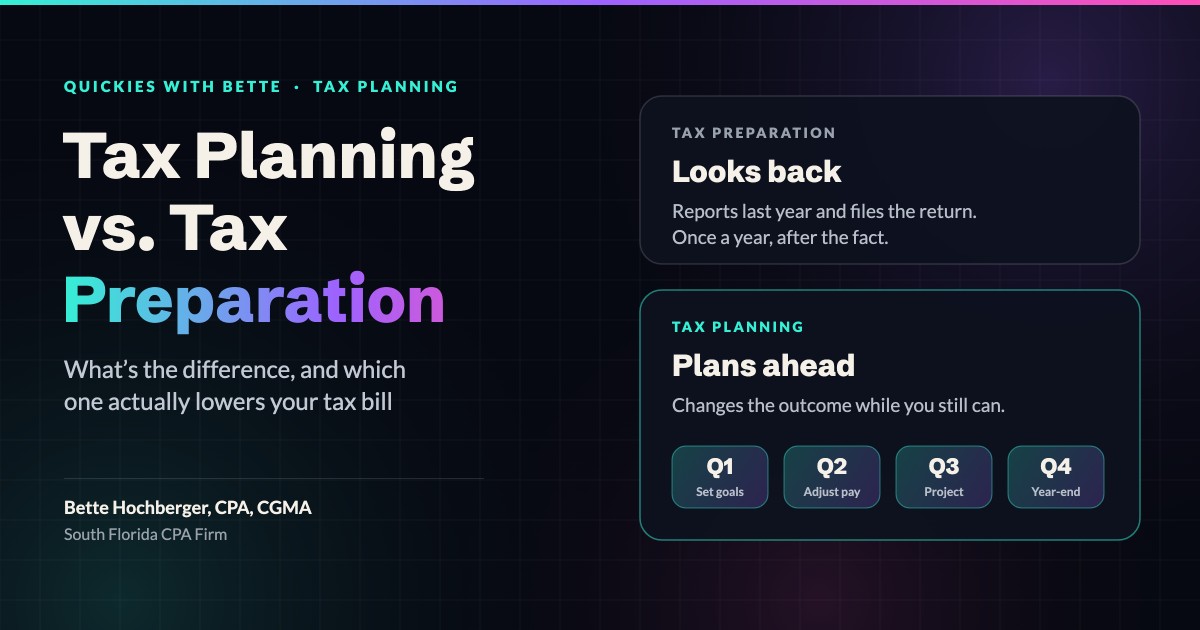
The difference between year-end planning and tax filing is simple: planning still gives you choices. Once January 1 arrives, most of the moves above are off the table for 2026. If you want help deciding which ones fit your business, real estate or investments, our team offers tax planning and strategy and focused tax planning sessions. Contact Bette Hochberger, CPA, CGMA to start the conversation.
This article is for general information and is not tax, legal or investment advice for your specific situation. Tax rules change, and the right approach depends on your facts. Talk with a qualified professional before acting.
Sources: IRS 2026 inflation adjustments; IRS Publication 946; IRS: One, Big, Beautiful Bill Act deductions.